
1. Context and challenges of creating apps with AI
Generative AIs are transforming the NoCode space by enabling rapid creation of applications without coding. But even when AI produces tailor-made tools without you having to code, the underlying code exists, evolves, and must be maintained. The "NoCode AI" can mask hidden costs and a lack of traceability.
In this context, companies are seeking architectures that are more robust, combining speed and control: standardized back offices, no-code automation tools and intelligent processing systems that remain maintainable and secure in the long term.
1.1. The "NoCode AI" generates underlying code
When you use AI assistants to design applications without writing code, you often think that everything generated remains in the NoCode sphere. Yet the code produced by Claude, Codex or other AIs is indeed code: files, dependencies, business logic and scripts that assemble the underlying building blocks.
This code isn’t magic: it must be versioned, tested, secured, and maintained like any other software.
Over time, each added feature generates even more code and multiplies the integration points between modules, creating a technical debt that accumulates and makes future evolutions more complex. Moreover, this generated code is not necessarily standardized: it may be tailor-made, poorly documented and difficult to reuse outside the initial context. The fragmentation risk is real: information silos, UI/UX inconsistencies, uneven security, tool dependencies, and limited interoperability between systems.
The practical consequence is simple: even in an AI-optimized NoCode ecosystem, this work must be framed by clear principles: governance of AI models, version and generator traceability, security and performance testing, and above all an architecture that separates the data system, orchestration, and AI tools.
It is precisely in this context that Airprocess proposes to stay the central and standard backoffice, ensuring that the AI is used only for its intelligence in data processing and generation, without introducing new code, and that the whole remains interoperable and secure.
1.2. Technical debt and fragmentation risks
AI-powered NoCode solutions, which generate underlying code, create inevitable technical debt. The code generated by models like Claude or Codex is not a finished stable product: it evolves with model updates, prompts, and input data. Each new feature or adjustment can introduce new dependencies that are hard to trace: testing, debugging, and backward compatibility.
Without rigorous management, one sees security, compliance, and performance debt emerge. Moreover, AIs are so proficient at producing code that fragmentation develops very quickly: each generated or assembled application may adopt different conventions in data structures, exchange formats, authentication mechanisms, hosting, and UI/UX.
The result is information silos, duplication of business rules and incompatibilities between systems. The snowball effect translates into rising integration costs, longer lead times, and operational complexity that hampers innovation. This debt and fragmentation directly impact teams’ ability to deliver quickly while ensuring security, traceability, and compliance.
For organizations, the challenge is clear: without standardization and governance, each AI-derived addition multiplies fragility points and starts a spiral of costs that undermines long-term value. A controlled architecture aims to contain these risks by establishing solid and reusable foundations.
2. Airprocess as central NoCode backoffice
Airprocess acts as the ecosystem's central NoCode backoffice, aligning operational flexibility and standardization for all apps. By centralizing data and process management, it allows adding structures and views without adding any new code, ensuring a common and evolvable base.
This approach reduces silos, improves interoperability between tools and ensures security, sovereign hosting and real-time collaboration.
Unlike solutions that generate code tailored to each need, Airprocess maintains a homogeneous and enduring architecture, ready to integrate with automations and LLMs without burdening software maintenance. It is the stable foundation on which to build high-performing and scalable AI experiences.
2.1. Airprocess keeps the backoffice flexible and standard
Airprocess acts as the heart of the backoffice while remaining both flexible and standard.
By enabling data modeling via forms and models, and then creating presentation views without writing a line of code, it guarantees a common structure for all use cases, whatever the apps created around it. This approach centralizes data governance, business rules and permissions, improving security and traceability, while facilitating real-time collaboration between teams.
Unlike point AI solutions that generate silos, Airprocess offers a unified architecture where changes to models or interfaces do not require rewriting the source code and do not fragment the ecosystem. Adding domains, fields or views is done via controlled NoCode components, with no risk of loss of coherence between apps, processes and workflows.
Thanks to this flexibility, organizations can steer product evolution and regulatory requirements in one place, with sovereign hosting and built-in backup mechanisms. By optimizing data, UI and rules exchanges, Airprocess becomes the stable foundation on which automations and LLMs connect, while avoiding the accumulation of technical debt tied to ad hoc developments.
2.2. No new code when adding structures
Adding a structure in Airprocess does not mean writing new code. When you define a new data model, associated forms and the corresponding views via the NoCode editor, you extend the back office without touching the source code. Technically, this is simply settings stored in standard JSON.
This approach preserves a homogeneous and centralized architecture, facilitating security and compliance. Each new structure integrates immediately into the rule engine, workflows and existing access rights, avoiding silos and redundancies.
The system automatically generates APIs, validations and interfaces around the structure, and all future evolutions are done by configuration rather than writing code.
In practice, you can multiply models, views and business rules without adding a single line of code. For advanced needs, you can enrich the system with automations, but without touching the core application. To do this, Airprocess has native connectors with n8n, Make, and Zapier, opening access to more than 3000 software tools and coordination with any LLM.
In summary, adding structures in Airprocess remains a no-code, durable and scalable operation that preserves the unity, security and interoperability of the back office in the long term, and across the organization since the tool enables creating applications for all business units.
3. Three-tier NoCode-Automation-LLM architecture
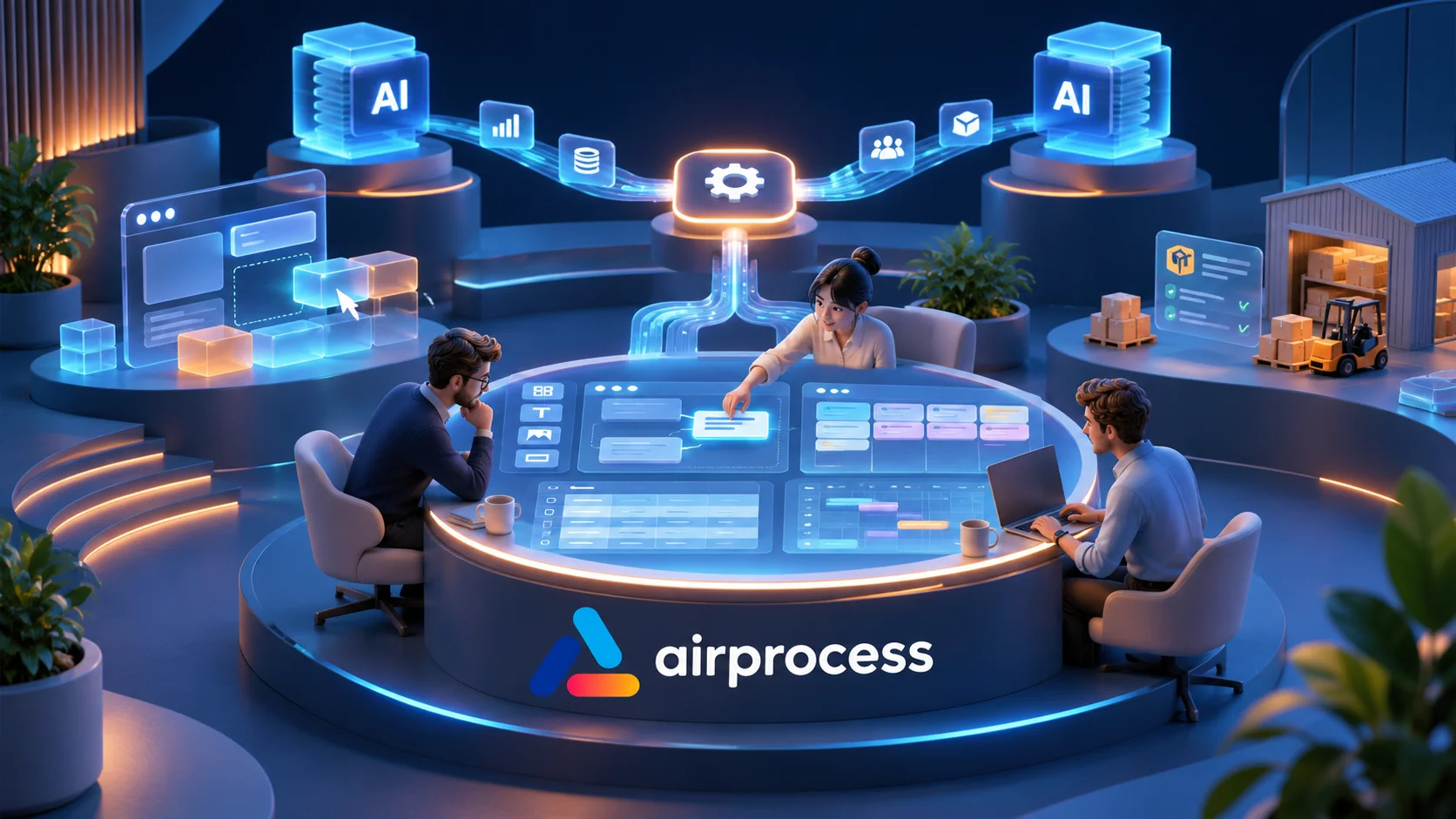
This architecture rests on three complementary layers that optimize business value without increasing code burden:
- At the core, Airprocess, the flexible and standard NoCode backoffice that centralizes data, rules and workflows.
- Around it wraps a no-code automation layer capable of triggering processes via webhooks and APIs toward N8N, Make or Zapier, without ever touching the source code.
- Finally, a dedicated LLM is tasked with executing intelligent tasks, interpreting requests and generating results, while staying perfectly detached from software maintenance. This chain ensures fast implementation, interoperability, security and scalability, while preserving a durable and manageable technical foundation for the business.
3.1. Airprocess workflow to automation via webhooks
In Airprocess, every relevant business event can trigger an automation via a webhook or an API call.
Concretely, you define the event that sends an HTTP request to your automation platform (Make, N8N, Zapier) and you attach the data describing the context: item ID, action type, data from the model or the form, and user context, etc...
Once received, the automation orchestrates the sequence: data transformation, API calls and asynchronous tasks, or calls to the LLM via the dedicated integration. The LLM can process data, generate results and steer actions without writing any code, while staying strictly within the automation tool.
The response is sent back via the Airprocess API which reinjects the information into Airprocess: updating a record, creating new data, generating documents, notifications, etc... anything is imaginable.
This loop ensures that Airprocess remains the NoCode core, coordinating flows without developing new components. In short, a seamless architecture: Airprocess triggers, the automation orchestrates, the LLM provides the intelligence and produces the data, and Airprocess presents the result to users, via its standard views (tables, calendars, timelines, kanban, image galleries, cards, charts, dashboards).
3.2. Dedicated LLM for processing without maintenance of code
The benefit of this architecture is that AI stays focused on processing data and performing intelligent tasks without having to write or maintain application code.
Integrated into the Airprocess gateway via automation, the LLM receives incoming data, enriches it, categorizes it, and generates structured results that feed Airprocess workflows directly, without business logic being encapsulated in code. Its role is to transform the need into actionable output: entity extraction, summaries, classification, deduction of the operational itinerary, message generation, or rule-based decisions.
The results are returned to the automation tool which orchestrates the rest of the process and reinjects the information into Airprocess.
This approach avoids adding code and the debt that goes with it: the system remains controllable via models, prompts and automation configurations rather than through code layers. The architecture also allows isolating incidents and to evolve the LLM's behavior without touching the produced code: we adjust prompts and variants, update connectors and automation nodes, while preserving a stable and auditable base.
4. Conclusion
Airprocess enables creating bespoke business applications, without coding. By adopting a three-tier architecture NoCode + Automation + LLM, Airprocess enables companies to integrate AI in a structured and standardized way by eliminating the fragmentation effect that occurs when you directly create applications and code with generative AI. If you want to explore the topic further, book an appointment with us directly for a demo!