1. Understanding the NoCode, Automation, AI Alliance
The alliance between NoCode, automation, and AI is transforming how businesses design, deploy, and optimize their processes.
NoCode provides visual interfaces and functional blocks that reinvent building applications without writing code, while automation structures repetitive tasks into reliable and reproducible workflows. Integrated AI brings intelligence, enabling solutions to adapt in real time.
Together, these levers reduce deployment times, lower costs, and foster a culture of continuous iteration, all while limiting the need to produce and maintain code.
For teams, this means moving from experimental prototyping to operational solutions more quickly, with better alignment to business objectives.
1.1. Speed of no-code development
The NoCode and automation duo, reinforced by AI, speeds development by allowing teams to focus on value and user experience rather than writing code.
In practice, starting a new project involves selecting a set of suitable NoCode tools, quickly mapping the user flow, and reusing predesigned components. Prototypes and MVPs deploy in days, or even hours, thanks to visual drag-and-drop blocks, process templates, and ready-to-use connectors.
AI integration, such as content generation or real-time form optimization, speeds up testing and improves the user experience without adding code.
1.2. Reducing Prototyping Costs
Reducing prototyping costs through the NoCode, automation and AI alliance translates into several concrete levers.
NoCode tools enable quickly designing an MVP without writing code, reducing initial costs and time-to-market. By combining automation, you can orchestrate flows between apps and databases without a developer, avoiding expenses related to API creation or infrastructure configuration. Generative AI, for its part, enables generating content, user scenarios or business rules adapted to real-world scenarios.
In practice, you start with templates and reusable blocks, drag-and-drop and ready-to-use connectors. Prototypes become functional in hours rather than days, significantly reducing development and validation costs.
Finally, total cost of ownership decreases as prototypes evolve into scalable solutions, because adjustments are made via parameters rather than code, and maintenance remains predictable.
2. Concrete use cases and business benefits
This section explores concrete scenarios where NoCode tools, automation and AI complement each other to transform the business.
By combining no-code platforms with automated flows and generative AI models, teams accelerate the creation of internal applications, optimize customer journeys, and strengthen operational agility. We see how repetitive processes can be automated without becoming dependent on traditional development, how data fuels real-time personalized responses, and how marketing, HR, or customer service teams benefit from better traceability and increased precision.
This practical approach promotes cost reduction, faster execution, and a better user experience.
2.1. Automated customer workflow
An automated customer workflow, built with NoCode tools, automation and AI, transforms the customer experience and operational performance.
With AI and automation, one can address virtually infinite use cases: for example, incoming data can trigger automation rules, create a customer record in the CRM and assign tasks to the team without manual intervention.
Automatic notifications keep the team informed, reducing contact lead times and lost leads. For the customer, the experience is seamless: personalized confirmations, transparent tracking and access to resources tailored to the stage of the journey.
In this framework, AI enriches the customer profile in real time, recommends the most relevant content or offers and generates personalized messages, while staying consistent with the brand.
Automation also ensures compliance and traceability: each step is documented, facilitating audits and continuous improvement. This type of flow is scalable: it adapts to volume and can be reused across different products or markets without heavy reprogramming, thanks to reusable NoCode blocks and ready-to-use AI models.
2.2. Generative AI for personalized content
When generative AI, NoCode tools and automation are combined, content personalization becomes scalable and fast.
In practice, you feed a generative AI with customer data from a CRM or marketing platform without writing a line of code, thanks to no-code connectors. You can generate emails, landing pages, product descriptions, or messages tailored to each segment, while respecting preferences and the user journey.
To start, the team defines modular templates and prompts: a framework for subject and tone, local or seasonal variants, and personalization rules. Automation flows trigger generation when an event occurs (new lead, cart abandonment, visit of a product page), then publish or preview the content in relevant channels after approval.
Important: put in place quality guardrails (human proofreading, safety filters, GDPR compliance) and models that guide the style.
3. Best practices and effective implementation
To get the most from the NoCode, automation and AI alliance, effective implementation relies on a progressive approach focused on business objectives.
Start by mapping value-added processes and choosing tools that integrate smoothly. Prefer simple use cases to start, with quality controls and iterative testing, to avoid side effects and technical dependencies. Define clear success criteria, implement data governance, and ensure appropriate security.
To achieve seamless integration between NoCode tools, automation and AI, prefer a multi-layer architecture:
- a data and presentation layer (the back office)
- a layer of orchestration (n8n, Make, Zapier)
- a layer of intelligence (the LLM of your choice)
Define a single source of truth (CRM, database or spreadsheet) and map fields between tools so that AI actions receive the right data.
Use webhooks or API connectors to trigger processes when events occur (sign-up, ticket update, payment).
Test each link: send data samples and verify that the flow ends with an expected action, such as sending a personalized email generated by AI or updating a status.
Monitor performance and errors with centralized logs and simple alerts. To gain agility, prefer tools that expose standard APIs and data-oriented connectors; avoid heavy dependencies between platforms, so you can replace one without breaking the rest.
Finally, document the data schema and business rules.
4. Conclusion
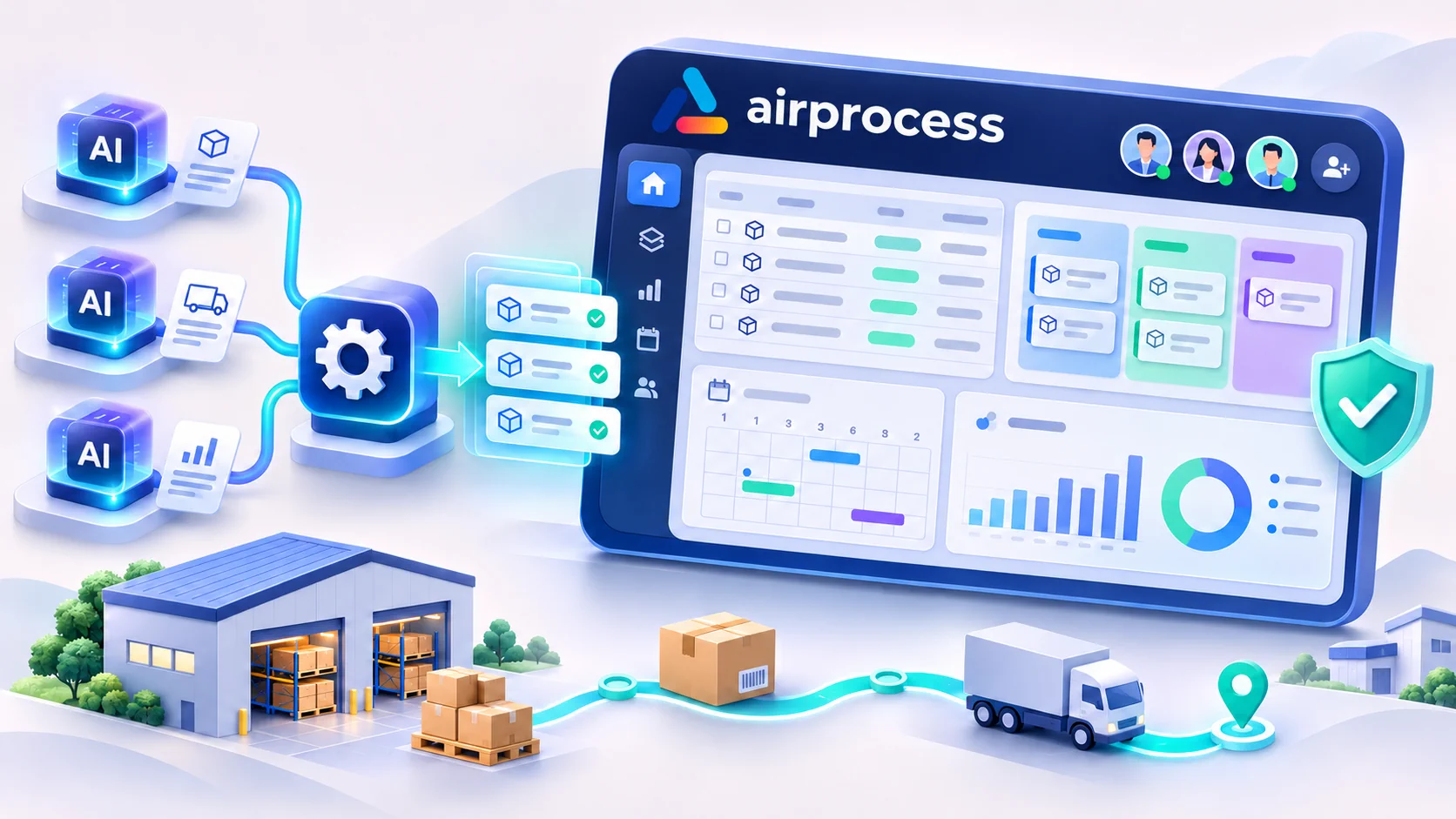
Getting the best from the NoCode + Automation + AI alliance means building a sustainable, cross-functional AI infrastructure for all the company's services, with little to no code dependency. On this topic, Airprocess can become your best ally in the long term: it orchestrates automations, triggers AI actions and processes, and retrieves results to present to users in a simple and standardized interface.
If you’d like a demo, please feel free to book a slot directly on our Calendly!