
Are you tired of payment delays and endless disputes with your clients?
Imagine a solution where every amicable negotiation case is managed smoothly, from first contact to resolution.
Thanks to Business Process Management (BPM) from AirProcess, your company can automate repetitive tasks, improve process visibility, and optimize every step of the negotiation.
No more endless court actions and costly lawyer interventions!
By integrating a BPM software like AirProcess, you can structure your workflows, reduce collection times, and strengthen business relationships.
In this article, discover how BPM can transform the management of unpaid receivables, facilitate the setup of amicable agreements, and offer concrete solutions to improve your financial results.
So, get ready to revolutionize your approach to amicable collections and provide quality service to your clients!
1) Understanding BPM and its role in amicable negotiations
a) Definition and principles of BPM
1) What is BPM?
Business Process Management (BPM) is a structured method to manage and improve an organization’s business processes.
This approach aims to make operations smoother and to ensure that each process step is performed consistently and optimally.
By integrating technological tools, BPM enables you to:
- 1️⃣ Automate repetitive tasks.
- 2️⃣ Improve visibility over operations.
- 3️⃣ Facilitate informed decision-making.
Thus, a company can track in real time the progress of amicable negotiation cases and adjust its strategies accordingly.
2) What are the main benefits of BPM?
BPM offers numerous benefits for companies:
- Reduction of errors: by automating processes, BPM minimizes the risk of human errors, especially in receivables management and payment reminders.
- Time savings: administrative tasks are completed faster thanks to automation, allowing employees to focus on higher-value activities.
- Improved compliance: BPM ensures that all procedures comply with current regulations, reducing the risk of non-compliance.
- Transparency: managers can monitor the status of processes in real time, quickly identifying bottlenecks and weaknesses.
Therefore, using BPM in the management of amicable negotiations allows tracking each step, from sending formal demand letters to mediation with debtors, ensuring that every action is logged and documented.
3) How does BPM optimize administrative processes?
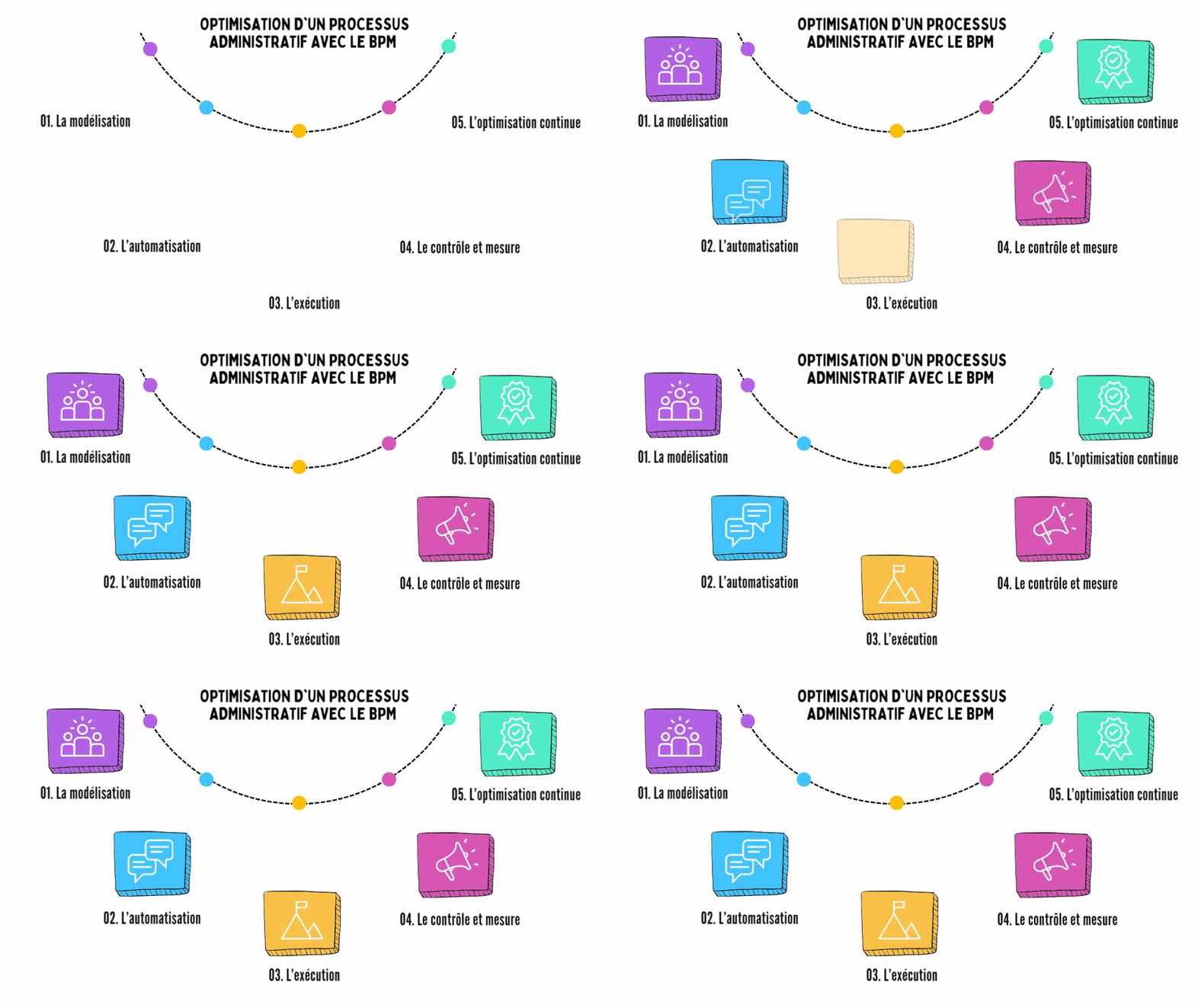
Optimization of an administrative process with BPM
BPM optimizes administrative processes by applying several key principles:
- Modeling: each process is mapped to identify steps and decision points. This provides a clear overview and helps detect potential issues.
- Automation: repetitive and time-consuming tasks are automated using specialized software, freeing up time for employees and reducing processing times.
- Execution: processes are executed according to defined rules, ensuring consistency and regularity in daily operations.
- Control and measurement: process performance is monitored using KPIs (key performance indicators), allowing continuous evaluation and real-time adjustments.
- Continuous optimization: collected data is analyzed to identify possible improvements, ensuring ongoing evolution and adaptation to new market requirements.
b) The role of BPM in amicable debt collection
1) Why use BPM to track amicable negotiations?
Business Process Management (BPM) plays an essential role in tracking amicable negotiations by bringing structure and optimization to each stage of the collection process. In addition, it provides a global view of all ongoing cases, their current processing stage, and the amounts involved.
By automating repetitive tasks and providing real-time visibility, BPM allows companies to manage disputes proactively.
This helps prevent payment delays and maintain good commercial relationships with debtors.
As a result, managers can monitor negotiation progress and quickly adjust their strategies as needed.
2) What are the benefits for an SME?
For an SME, using BPM in amicable collections offers several distinct advantages:
- 1️⃣ Cost reduction: automating processes reduces the need for manual interventions, helping to lower costs.
- 2️⃣ Improved cash flow: by accelerating receivables recovery, BPM contributes to better cash flow management, which is vital for small and medium-sized businesses.
- 3️⃣ Strengthened customer relationships: structured and transparent tracking of negotiations helps preserve positive relationships with clients, even in case of financial disputes.
- 4️⃣ Time savings: teams can focus on higher-value tasks rather than repetitive administrative activities.
- 5️⃣ Compliance: BPM ensures that all collection steps comply with applicable regulations, thus reducing the risk of non-compliance.
3) Examples of companies using BPM for receivables management
An SME could adopt a BPM software to automate sending payment reminders and track communications with debtors.
If this company used BPM, it would see a reduction in collection times, going from 60 days to 40 days to recover payments.
Thus, automatic reminders help better manage delays and maintain positive relationships with clients.
A consumer goods supplier could use BPM to centralize all data related to receivables, thus facilitating access to payment and negotiation history.
If a food manufacturer used BPM, it could improve its cash flow thanks to a clearer overall view of receivables, enabling better management of reminders and payments.
Consequently, cash flow would be stabilized, allowing for more accurate financial planning.
A telecommunications company could implement BPM to track and manage disputes with customers.
If this company adopted BPM, it would see a decrease in conflicts and an increase in customer satisfaction, by offering transparent and responsive tracking of complaints and resolutions.
Customers would then benefit from smoother communication and faster problem resolution, which would strengthen their loyalty to the company.
A commercial debt collection agency could integrate BPM to structure its internal processes.
If this agency used BPM, case tracking would become more efficient and transparent for creditors and debtors.
For example, the agency could set up interactive dashboards to monitor recovery status in real time, allowing quick intervention when needed and clear communication with clients.
Finally, in the banking sector, it is common that loan installments go unpaid: by implementing a structured process for amicable negotiation, managers can track the progress of each case in real time, log every letter, every appointment with the client, as well as the plan defined with the client to manage their debt.
From the perspective of the back office responsible for handling these amicable negotiations, this allows them to manage many cases calmly, because everything is recorded, the history is clear, as are the next steps to follow in the negotiation process.
Our experience in the field has also shown that rigorous follow-up of amicable negotiations reduces by at least 20% the number of cases that will be referred to the litigation department, thus limiting the actions required for recovery.
c) Essential features of a BPM software
1) What are the key features of a BPM tool?
A BPM software offers several key features that allow managing and optimizing business processes.
Here are some of the most important:
- Process modeling: allows creating workflow diagrams to visualize and design business processes.
- Task automation: automates repetitive and routine tasks, thus reducing the need for manual intervention.
- Task management: helps assign, track, and manage tasks to ensure they are completed on time.
- Real-time monitoring: provides dashboards and real-time reports to monitor process performance.
- Analytics and reporting: offers analysis tools to evaluate process performance and identify areas for improvement.
- Integration with other systems: enables connecting BPM with other software and systems used by the company for better data cohesion.
2) How do these BPM features facilitate dispute management?
Feature | How it facilitates dispute management |
Process modeling | By visualizing processes, companies can identify friction points and improve them to avoid future disputes. |
Task automation | Reduces the risk of human error by automating tasks such as sending payment reminders and documenting communications. |
Task management | Ensures that all steps of the dispute resolution process are followed, from receiving the complaint to its resolution, without missing any critical step. |
Real-time monitoring | Allows monitoring the status of ongoing disputes, reacting quickly to new claims and tracking resolution deadlines. |
Analytics and reporting | Helps identify recurring causes of disputes and implement corrective measures to avoid them in the future. |
Integration with other systems | Facilitates access to all relevant information for dispute resolution, ensuring data is consistent and up to date. |
2) Implementing BPM to track amicable negotiation cases
a) Choosing and implementing a BPM software
1) How to choose the right BPM software?
It is important to consider several factors to make an informed choice.
Here are some elements to consider:
- 1️⃣ Assess the company’s specific needs.
- 2️⃣ Compare features offered by different software solutions.
- 3️⃣ Consult reviews and testimonials from other users.
- 4️⃣ Check compatibility with existing systems.
- 5️⃣ Consider cost and return on investment.
2) What criteria should be considered during selection?
When selecting a BPM software, several criteria should be taken into account to ensure it meets the company’s needs:
- 1️⃣ Ease of use: the software should be intuitive and easy for employees to use.
- 2️⃣ Customization: it should allow customizing processes according to the company’s specific needs.
- 3️⃣ Integration: the software should integrate easily with systems and tools already in place.
- 4️⃣ Support and training: the vendor should provide strong technical support and training for users.
- 5️⃣ Scalability: the software should be able to grow with the company and adapt to future needs.
3) Steps for deploying a BPM software
Deploying a BPM software requires careful planning to ensure successful integration.
Here are the key steps to follow:
Step | Description |
Needs analysis | Identify the business processes to optimize and the company’s specific needs. |
Software selection | Select the BPM software that best meets the defined criteria. |
Configuration | Customize the software according to the company’s needs and configure the processes. |
Training | Train employees to use the software to ensure rapid and effective adoption. |
Deployment | Launch the software in a pilot phase, then roll it out across the company after validation. |
Monitoring and optimization | Monitor software performance and make adjustments to continuously optimize processes. |
b) Training and team adaptation
1) Why is employee training so important?
Employee training ensures that the adoption of Business Process Management (BPM) goes smoothly and that processes are used correctly.
Thus, good training allows you to:
- 1️⃣ Improve understanding of the tools: employees must understand how to use BPM tools to maximize their potential.
- 2️⃣ Reduce errors: adequate training reduces the risk of human errors when using the system.
- 3️⃣ Increase employee engagement: well-trained employees are more confident and motivated to use new technologies.
- 4️⃣ Ensure rapid adoption: the more comfortable employees are with BPM, the faster and smoother adoption will be.
- 5️⃣ Facilitate process optimization: trained employees can identify and suggest improvements to existing processes.
2) How to train your team effectively on BPM?
To train your team effectively on BPM use, you should follow several steps:
- 1️⃣ Skills assessment: identify employees’ current skills and determine gaps to fill.
- 2️⃣ Develop a training program: create a structured program that covers all BPM features and best practices.
- 3️⃣ Hands-on training: organize practical training sessions where employees can use BPM in real scenarios.
- 4️⃣ Monitoring and evaluation: track employee progress and assess their understanding through regular tests and evaluations.
- 5️⃣ Feedback and adjustments: collect employee feedback to continuously improve the training program.
3) Resources and tools for continuous training
To ensure continuous training, it is useful to have a variety of resources and tools:
- 1️⃣ Manuals and user guides: provide detailed documents on using BPM.
- 2️⃣ Video tutorials: use explanatory videos to demonstrate different BPM features.
- 3️⃣ Webinars and workshops: organize interactive sessions to deepen knowledge and answer questions.
- 4️⃣ Technical support: provide a technical support team to assist employees in case of issues.
- 5️⃣ Online communities: encourage participation in forums and discussion groups where employees can share tips and experiences.
3) Negotiation strategies optimized by BPM
a) Preparation and case assessment
1) How to structure a negotiation plan with BPM?
Structuring a negotiation plan with BPM makes the process more organized.
Here’s how to proceed:
- Identify objectives: clearly define negotiation objectives, such as the amount to recover or payment terms.
- Map stakeholders: identify all parties involved, including debtors, creditors, and mediators.
- Data analysis: use BPM tools to analyze historical receivables and payment data.
- Scenario development: create different negotiation scenarios based on analyzed data to anticipate debtors’ responses.
- Step planning: establish a detailed schedule of negotiation steps, including meeting dates and the deadlines for each action.
2) What key elements should be included in each case file?
To prepare an amicable negotiation file with BPM, you should include certain key elements:
Elements | Description |
1️⃣ Debtor information | Contact details, payment history, and payment behavior. |
2️⃣ Amount of the receivable | Amount due, accrued interest, and any additional fees. |
3️⃣ Relevant documentation | Contracts, invoices, reminder letters, and any other documents related to the receivable. |
4️⃣ Communication history | Records of calls, emails, and letters sent and received. |
5️⃣ Settlement proposals | Different payment options proposed and responses received from debtors. |
3) Tools and techniques for claims analysis
Claims analysis enables negotiation preparation.
Here are some tools and techniques to use:
- Data analysis software: use tools like Tableau or Power BI to visualize and analyze receivables data.
- BPM dashboards: implement custom dashboards to track the progress of claims and payments.
- Segmentation techniques: categorize claims based on criteria such as amount owed, duration of non-payment, and debtor behavior.
- Predictive modeling: use predictive models to anticipate negotiation outcomes based on historical data.
- Collaboration tools: integrate project management tools like Trello to coordinate the collection team’s efforts and ensure smooth communication.
b) Conducting negotiations
1) What are the best practices for effective amicable negotiations?
To conduct effective amicable negotiations, you should follow certain best practices:
- Thorough preparation: gather all relevant information about the debtor and the receivable before starting the negotiation.
- Active listening: take the time to listen to the debtor’s concerns and reasons to better understand their situation.
- Clear communication: use simple and direct language to explain the negotiation terms and expectations.
- Flexibility: be willing to adapt proposals according to the debtor’s needs and payment capacity.
- Documentation: keep a detailed record of all communications and agreements to avoid future misunderstandings.
2) How to handle debtors’ objections and refusals?
Handling debtors’ objections and refusals can be challenging, but there are strategies to address them:
- Stay calm and professional: do not be carried away by emotions and respond in a composed manner.
- Understand the objection: identify the reason behind the objection to respond appropriately.
- Provide alternative solutions: propose different payment or installment options to address the debtor’s concerns.
- Emphasize the benefits: highlight the advantages of reaching an amicable agreement, such as avoiding costly legal procedures.
- Be persistent, but respectful: continue negotiating while respecting the debtor’s limits and situation.
3) Using BPM features to facilitate communication
BPM features can greatly facilitate communication during amicable negotiations:
- Automated reminders: automatically send payment reminders and notifications to keep the debtor informed.
- Communication tracking: use tracking tools to record all interactions with the debtor, ensuring a clear and accessible trail.
- Interactive dashboards: provide a real-time overview of negotiation and payment status, facilitating decision-making.
- Communication portals: offer debtors access to an online portal where they can view their file, ask questions, and submit documents.
- Data analysis: use data analysis to understand trends and adapt communication strategies based on debtor behavior.
c) Conclusion and documentation of agreements
1) How to document and archive amicable agreements?
Documenting and archiving amicable agreements ensures clarity and compliance of negotiations.
Here’s how to proceed:
- Create digital folders: use document management tools to create and organize digital folders for each agreement.
- Record all communications: document all communications with the debtor, including emails, phone calls, and meetings.
- Digitize physical documents: scan and save digital copies of all physical documents, such as signed contracts and reminder letters.
- Use standardized templates: use standardized document templates to ensure consistency and clarity of agreements.
- Secure storage: ensure that all documents are stored securely, with controlled access to protect information confidentiality.
2) What documentation formats are recommended?
To document amicable agreements, it is recommended to use specific documentation formats:
Format | Description |
Use the PDF format for final documents to ensure they cannot be modified without authorization. | |
Text formats (Word, Google Docs) | Use text formats for drafting and reviewing documents before finalization. |
Spreadsheets (Excel, Google Sheets) | Use spreadsheets to track payments and deadlines, and to record financial information. |
Databases | Store information in databases to facilitate search and access to archived documents. |
Emails | Keep electronic copies of important communications in standard email formats. |
3) How to ensure traceability and compliance of case files?
To ensure traceability and compliance of case files, follow these steps:
- File numbering: assign a unique number to each case to facilitate tracking and identification.
- Change log: maintain a change log to record all modifications made to documents and files.
- Access controls: implement access controls to restrict who can view and modify documents.
- Regular audits: conduct regular audits to ensure all files are complete and compliant with applicable regulations.
- Long-term archiving: use long-term archiving solutions to store documents securely and ensure their integrity over time.
4) Integrating AirProcess into tracking amicable negotiation cases
AirProcess, as a flexible and powerful no-code platform, offers a range of features that can be integrated into case tracking.
Here is how AirProcess can add value in this area:
a) Automation and structuring of processes
AirProcess allows structuring a negotiation plan in a few simple steps thanks to its tools for creating custom workflows:
- Objective identification: use AirProcess’s flexible forms to clearly define negotiation objectives, such as the amount to recover or payment terms.
- Stakeholder mapping: identify all parties involved.
- Data analysis: AirProcess dashboards and analytics tools allow analyzing historical receivables and payment data.
- Scenario development: create different negotiation scenarios using AirProcess’s modeling features to anticipate debtors’ responses.
- Step planning: use calendars and task management tools to establish a detailed schedule of negotiation steps.
b) Tracking and documenting agreements
How to document and archive amicable agreements?
AirProcess offers robust solutions to manage amicable negotiations:
- Create digital folders: use AirProcess’s document management features to create and organize digital folders for each agreement.
- Record all communications: document all communications with debtors, including emails, phone calls, and meetings, directly within the platform.
- Digitize physical documents: scan and save digital copies of all physical documents, such as signed contracts and reminder letters.
- Use standardized templates: use standardized document templates provided by AirProcess to ensure consistency and clarity of agreements.
- Secure storage: ensure that all documents are stored securely with strict access controls to protect information confidentiality.
6) Conclusion
In this article, we explored the importance of Business Process Management (BPM) in tracking amicable negotiation cases.
We detailed the fundamental principles of BPM, its benefits, and how it can optimize administrative processes and amicable collections.
Examples illustrated BPM’s effectiveness in various companies, showing how it reduces costs, improves cash flow, and strengthens customer relationships.
Finally, we discussed essential BPM software features and best practices for training teams and managing negotiations.
Thus, BPM brings a methodical structure and technological tools that transform receivables and dispute management into a smooth and transparent process.
Consequently, integrating a no-code platform like AirProcess further facilitates this transformation by enabling deep customization and automation of workflows, making negotiations more efficient and better documented.
To learn more about implementing and optimizing business processes with BPM, we invite you to explore our other articles and resources available on our site.
You will find detailed guides, case studies, and video tutorials to deepen your knowledge and improve your practices.