

Have you ever thought about implementing a structured purchasing process for your company?
Well, that is precisely the topic we have looked into, and trust us, there are things to say!
So, what is a purchasing process and why is it so important?
In this article, we dive into the heart of purchasing operations, and you will see that in this field every detail matters.
From choosing suppliers to contract management, including negotiation and order tracking, each step is an essential link.
So, get ready to discover:
- How to define your needs precisely?
- Tips for an effective supplier search.
- The art of negotiation and contract management.
- How to use AirProcess to structure the workflow?
By the end of the read, you will have all the keys to structure or improve your purchasing process.
Now, without further delay, let’s move on to the first step!
1) Defining a purchasing process in a company
a) What is a purchasing process?
The purchasing process in a company is a series of actions with the objective of buying the goods and services needed for its proper operation.
This process comprises several steps, each playing a role in the cost optimization and operational efficiency.
b) The key steps of the purchasing process
1. Identification of needs and search for suppliers
The process starts with the detection of a specific need within the company.
This step involves a research phase to identify a reliable supplier who can meet the needs.
2. Negotiation and contract management
Once the supplier is identified, the purchasing and supply managers begin negotiations to obtain favorable conditions.
They also ensure that contracts comply with the company’s requirements.
3. Monitoring and quality control
The process includes verification and tracking of received orders.
This step serves to guarantee the quality of the purchased products or services and to maintain reliable traceability.
c) The purpose of the purchasing process
The main objective of a well-structured purchasing process is to minimize overall expenses while ensuring the availability of the resources needed in a timely manner.
Here, one of the aims of this strategic approach is to maintain the company's competitiveness in the market.
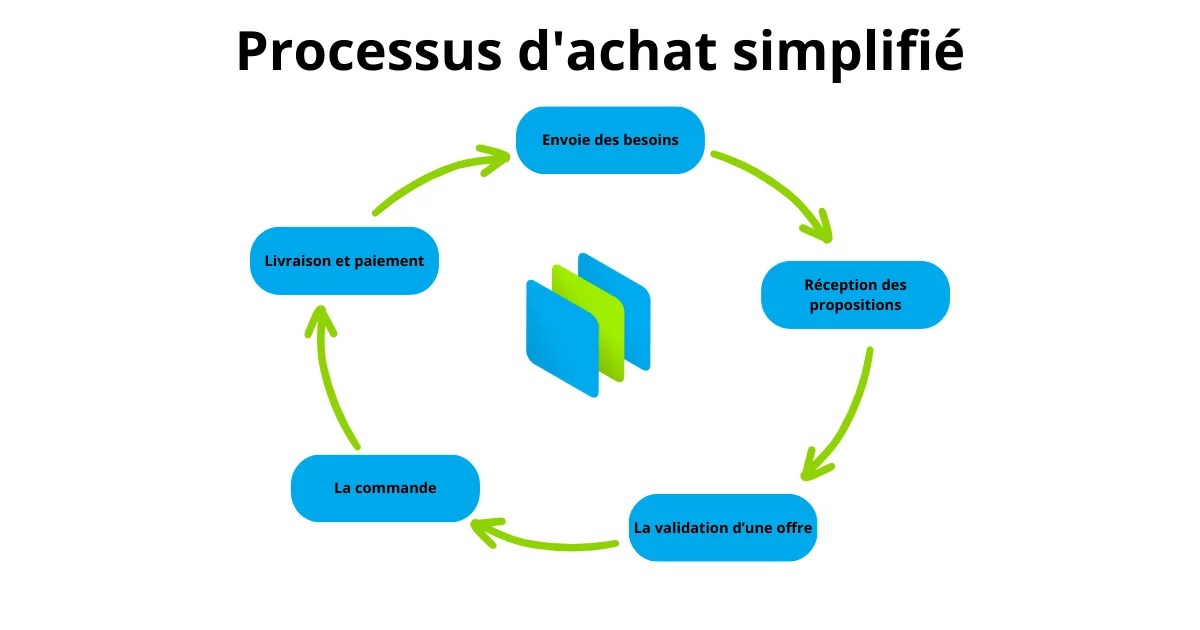
Now, let's explore in more detail through a practical diagram how these elements fit together.
2) Diagram of a simplified purchasing process
3) The purchasing process in ten steps
Step 1: Developing the company’s needs specification
1️⃣ Role of the buyer in expressing the need
The initialization of the purchasing process in a company begins with expressing the needs.
That is why this task is generally entrusted to an experienced buyer, or in their absence, to a designated team member.
Indeed, an inaccurate definition of the need at this stage could lead to notable gaps between what is expected and what is delivered.
2️⃣ The importance of the specification for a global view of needs
To be effective, it is advised to formalize these needs through an exhaustive specification.
This document, often prepared in a group, provides a comprehensive and detailed view of the company’s expectations.
It encapsulates the business requirements, the specifics of the product or service expected, the qualification criteria, the allocated budget, and even internal audits for an efficient mutualization of purchases.
3️⃣ Establishing inter-departmental communication for precise needs
For this to work, smooth and effective interaction between the different departments is required to delineate precisely the contours of the upcoming purchase.
This internal communication helps define key aspects such as the delivery date, the specific characteristics of the products or services, and the quality control modalities.
4️⃣ Analysis of stakeholders in preparation for supplier selection
This first step also includes a rigorous analysis of stakeholders.
This approach aims to effectively prepare the next step of the process, which is to study the company’s panel of suppliers.
This analysis thus helps refine procurement strategies and optimize supplier relationships for future purchases.
Step 2: The supplier search strategy
1️⃣ Understand the market for an effective selection
In the purchasing department, searching for suitable suppliers is a process that requires a good knowledge of the market and its players.
This step is crucial to mastering purchasing and ensuring a smooth transition during the order placement process.
2️⃣ Methods of supplier sourcing
1) Consulting the existing panel : use the company’s database to explore suppliers already known and integrated into your logistics chain.
2) Identifying new suppliers : you can adopt daily monitoring to discover new potential suppliers that match your procurement policy.
For this, use experience feedback and sourcing tools to enrich your panel.
3️⃣ Managing and evaluating the supplier panel : maintaining and regularly analyzing the supplier panel in your sector is good practice for an up-to-date view of the market.
This ongoing evaluation allows adjusting the company’s procurement strategies to market dynamics.
4️⃣ Transforming the need into a tender : after identifying appropriate suppliers, it is important to formalize the company’s needs into a clear and precise tender.
This facilitates communication with potential suppliers and ensures better purchasing management.
Step 3: The tender procedure in purchasing planning
a) The definition of the tender
The tender is in reality a procedure used by all companies.
It is a document where the specifier, i.e., the company, requests commercial proposals from several suppliers.
This step is strategic in the supply lines, as it requires time, organization, and specific skills.
b) Practical application of the tender
In this phase, companies that were preselected in previous steps are invited to submit their offers.
These proposals must meet the needs expressed in the specification, whether for products, services, or performances.
b) Methods of communicating the tender
Traditionally, the tender is transmitted to providers via email or postal mail.
However, the digital age has brought innovations enabling the dematerialization of purchasing and procurement, thus making these procedures more efficient.
c) Centralization and analysis of offers
Once offers are received, they must be centralized to facilitate analysis by the purchasing department, and this is where AirProcess can help you.
This step of the quality approach is useful to evaluate and compare the proposals received according to the defined criteria.
Step 4: Analyzing offers for supplier selection
a) Analysis of offers
The step of analyzing offers is fundamental in the optimization of the purchasing process.
It involves carefully evaluating all received proposals to identify the most advantageous for the company.
b) Process of analyzing offers
1️⃣ Centralization of offers : gather all offers in one place for coherent and structured analysis.
2️⃣ Multi-criteria analysis : first, you must evaluate the offers based on predefined criteria from the expression of need, such as quality, costs, timelines, etc.
Then, eliminate offers that do not meet the established requirements.
c) The methodology of analysis for effective selection
1️⃣ Identification of the offer components : examine in detail the constituent elements of each proposal.
2️⃣ Selection of competitive offers : identify proposals offering a significant competitive advantage for the company.
3️⃣ Communication on the final choice : share the final decision with the concerned stakeholders after thorough evaluation.
In general, this task falls to the purchasing director.
Step 5: Selecting an offer and finalizing the process
a) The objective of selecting the offer
The selection of the offer is the step where the company finalizes its choice among the most relevant proposals following the analysis.
Here, this decision determines the partner with whom the company will collaborate and directly affects the purchasing strategy.
b) The selection criteria
1️⃣ The criteria defined during the expression of the need : the selection is based on the characteristics and criteria initially established in the specification.
2️⃣ The criteria grid or qualification system : use of a standardized criteria grid to evaluate and compare offers.
c) Managing the number of offers
The buyer or the person in the purchasing department designated must monitor the number of offers received.
A too small number of offers can indicate the need to revise the request to attract more proposals. In the public sector, it is even common that at least three offers are studied; if applicable, the tender may become void.
Indeed, a company should ensure multiple sources of supply to maintain negotiation leverage when requesting procurement or service purchases.
d) Finalizing the supplier choice
After selecting the offer, the company enters a negotiation phase with the chosen supplier.
This step allows adjusting the terms of the agreement to best meet the company’s needs.
Step 6: The art of negotiation in the purchasing process
a) The need to negotiate
Negotiation is a key phase in the purchasing process, as it offers the company the opportunity to optimize its acquisitions.
Indeed, not negotiating an offer can mean missing out on significant advantages in terms of cost, quality, and service.
b) Preparation for negotiation
1️⃣ Identifying the clauses to negotiate : before the meeting, it is essential to identify all administrative and technical clauses that may be negotiated.
2️⃣ Defining the objectives to achieve : clearly determine your objectives and priorities.
Thus, you must know which aspects are most important to your company.
3️⃣ Preparing the arguments : prepare arguments and justifications to support your position during negotiation.
c) Establishing a collaborative relationship
Creating a positive relationship with the supplier is fundamental for an efficient negotiation process.
d) Reaching the best agreement
The aim of negotiation is to obtain an agreement that offers the best value for money, meets the precise needs of the company, and guarantees appropriate delivery times.
e) Finalization and internal validation
After successful negotiation, the result must be validated internally with the purchasing management before finalizing the agreement with the supplier.
Negotiation, far from being the preserve of only experts, is accessible to everyone and can be conducted effectively with proper preparation.
Step 7: Validation of the offer before contracting
a) Post-negotiation validation process
Once the negotiation is completed, offer validation is the next step.
It involves presenting the negotiated offer to the company’s decision-makers to obtain their approval before starting the contracting.
b) Involvement of decision-makers
1️⃣ The role of decision-makers : the offer must be reviewed and approved by the company’s managers or decision-makers.
This may include the purchasing management, financial managers, or other key stakeholders.
2️⃣ Communication and timelines : effective communication will be beneficial to avoid unnecessary delays.
Communication difficulties can lengthen the process and affect purchasing efficiency.
c) The validation step
1️⃣ Allocation of responsibilities : this step helps share the ownership of the purchase, ensuring consensus within the team.
2️⃣ Taking costs into account : since the purchase represents a cost for the company, a prudent decision is necessary before formally engaging with a supplier.
d) Optimizing the approval system
The effectiveness of the approval system will drive the speed of the validation process.
A well-optimized system can significantly reduce delays and improve operational efficiency.
e) The start of contracting
After internal validation, the company can proceed with contracting with the supplier, marking the start of a formal collaboration.
The validation of the offer is therefore an important milestone in the purchasing process.
It requires particular attention to ensure that the company’s commitment with the supplier is well considered and meets the company’s strategic and financial objectives.
Step 8: Establishing the contract with the supplier
a) The importance of defining partnership terms
Drafting a contract with the supplier helps formalize exchanges, establish a trust-based relationship, and clarify the terms of the commitment between the two parties.
b) Tips for writing effective terms and conditions (T&Cs)
1️⃣ Analysis of the general terms and conditions of sale (GTCs) : it is important to thoroughly analyze the general terms and conditions of sale to identify and assess potential risks.
2️⃣ Requesting specific terms : ask for clauses tailored to your company’s specific needs, thus justifying the need for a customized contract.
3️⃣ Time-based delimitation of the contract : a good practice is to set a validity period for the contract.
Indeed, this will allow renegotiation or requalification of the terms in the future.
c) Finalizing the agreement and payment
Once the terms are agreed, payment constitutes the final step that seals the agreement between your company and the supplier.
Step 9: Managing payment in the purchasing process
a) Meaning of payment in purchasing
Payment symbolizes the completion of the purchasing act.
Thus, it marks the acceptance of the service and reinforces the contractual relationship established between the company and the supplier, thereby ensuring mutual trust.
b) Payment terms
1️⃣ Definition of payment terms : in your contract, you should determine appropriate payment conditions, such as down payments, payment on delivery, installment options, or payment terms.
2️⃣ Adaptation to the needs of both parties : finding a payment agreement that suits both the company and the supplier will help maintain healthy cash flow and meet contractual commitments.
c) Post-payment follow-up
Once payment is made, it is important to ensure that all initially agreed conditions are met, to guarantee the compliance of the acquisition and the satisfaction of both parties.
Step 10: Monitoring of works and contracts
a) The importance of post-purchase monitoring
Monitoring of works and contracts is an essential, often overlooked step, but crucial to guarantee the efficiency and safety of the purchasing process.
b) Strategies for effective monitoring
1️⃣ Regular audits of contracts and purchases : it is advisable to conduct audits, monthly or quarterly, to monitor progress and compliance of contracts and purchases.
2️⃣ Definition of specific milestones : depending on the nature of the purchases, it is wise to set milestones to track the progress of work or delivery.
c) Maintaining a good buyer-supplier relationship
Rigorous monitoring helps ensure compliance with the conditions defined within the contractual relationship.
As a result, these simple actions help preserve and strengthen the relationship between buyers and suppliers.
d) Benefits of a rigorous method
An effective, well-structured follow-up offers multiple benefits to the company, notably in terms of securing supply and optimized management of supplier relations.
With the ten steps of the purchasing process defined, let’s now see how these principles apply concretely with the example of AirProcess.
4) Purchasing process, example with AirProcess
The AirProcess software can perfectly assist you in managing your purchasing processes.
Here is an example below:
The selection of a raw material supplier
Finding a supplier may seem like a trivial task!
Indeed, you go to Google and you type a query like “aluminum supplier,” and that is a good start.
But, if selecting a supplier involves several services, you must be able to route the information in a standardized way to the final decision-maker.
You therefore need to work collaboratively with a BPM tool, ideally equipped with a workflow engine.
In this example, we will have 4 actors :
Actor 1, he is responsible for :
- Finding suppliers.
- Sending the quotation request.
- Retrieving and entering information.
- Launching orders.
Actor 2, he is responsible for :
- Studying the offers.
- Selecting those that match the specifications.
Actor 3, he is responsible for :
- Validating the retained offers.
Step 1: The supplier base
The first step will be to list all the suppliers you will have found in a file.
Here, the idea is to display on a single document all the information about them.
If you already have an Excel file, you can import it into AirProcess.
The software will display the equivalent of your file, but in a more modern way.
Here, you simply prepare your form for entering the information.
Give a name to your application and off you go.
This task is performed by Actor 1
To get an idea of how AirProcess works, we invite you to watch the video below.
It explains how to manage incidents in a business, but AirProcess is a BPM (Business Process Management) software that can perfectly adapt to managing a purchasing process.
https://www.youtube.com/embed/tpdPXe0-xGs?start=19&feature=oembed
Step 2: sending your raw material needs
At this step, you have already drafted a specification of what you wish to buy and this document is sent.
This task is performed by Actor 1
Step 3: receiving commercial proposals
All proposals arrive gradually and are entered into the formulaire de AirProcess.
This task is performed by Actor 1
Step 4: selecting offers
Each offer is studied and if it matches the criteria of the specification, it is retained.
This task is performed by Actor 2.
Step 5: validating an offer
After studying the offers, one of them is selected and validated.
This task is performed by Actor 3
Step 6: placing the order
The final step of this process is to place the order.
Here, we have reached the end of the workflow and all steps of the process have been validated.
This task is performed by the Actor 1.
After exploring the detailed AirProcess example for purchasing management, it becomes essential to understand the role of the different actors in this complex process.
Who within the company plays a key role in purchasing decisions?
So, let’s examine this in the next section.
5) Who should be involved in your company’s purchasing process?
a) The key actors in the purchasing process
1️⃣ The purchasing management : the purchasing management plays a strategic role in coordinating and supervising the purchasing process.
It sets purchasing policies and strategies, ensuring optimization of resources.
2️⃣ The purchasing department : this service is made up of professional buyers; the purchasing department is responsible for implementing purchasing strategies.
These specialists drive operations from supplier selection to contract negotiations.
3️⃣ The department of purchases : this department ensures operational management of purchases.
It is responsible for supplying fournitures and services, while ensuring quality, cost, and delivery criteria.
4️⃣ The procurement manager : in charge of stock management and the supply chain, the procurement manager ensures the availability of the products needed for the company’s activities.
5️⃣ The purchasing teams : these purchasing teams, composed of buyers and coordinators, work closely with suppliers to optimize purchasing conditions and ensure internal needs are met.
b) Interdepartmental collaboration
Effective collaboration between the different departments (production, finance, quality, CSR) is essential to align purchasing objectives with the organization’s global needs.
Now you know the roles of the purchasing management, the purchasing department, and other actors in the optimization of the supply chain and stock management.
Now, let’s explore the factors to consider to design a high-performing and operational purchasing process for your company.
6) What to consider when designing your purchasing process?
a) The key factors to consider.
1️⃣ The purchasing and procurement strategy : define a clear purchasing strategy aligned with the company’s objectives and needs.
This includes identifying essential supplies and strategic partners.
2️⃣ Stock optimization : manage stock efficiently to avoid surpluses or stockouts.
The use of inventory management and planning systems can greatly contribute to this balance.
3️⃣ Choice of suppliers : select a panel of suppliers that are reliable and competitive, taking into account criteria such as quality, costs, responsiveness, and CSR compliance.
4️⃣ Operational processes : establish clear operational processes for each step of the purchase: from the purchasing request to the receipt and inspection of goods or services.
5️⃣ Control and audit : put in place control and audit mechanisms to ensure compliance and effectiveness of the process.
This may include internal audits and periodic evaluations.
6️⃣ Training and professionalization : invest in training and professionalization of the purchasing teams.
A qualified and well-trained staff is essential for the success of the purchasing process.
7️⃣ Technology and digitalization : integrate technological solutions to digitalize and automate the purchasing process.
This can improve efficiency, reduce errors, and accelerate operations.
b) The holistic approach
Adopt a holistic approach that considers the purchasing process as a whole, integrating interactions between the different departments and ensuring alignment with the company’s overall strategy.
This allows creating an agile and responsive purchasing system capable of supporting the company’s long-term goals.
With a well-defined purchasing and supply strategy, and optimized management of stock and suppliers, the question arises: when should we consider revisiting and potentially readjusting our purchasing process to stay competitive and operational?
7) When is it time to revise your purchasing process?
a) Key indicators for the revision
1️⃣ When there are changes in the company environment : if your company undergoes significant changes, such as expansion, reduction, or a change in its overall strategy, it is time to revisit your purchasing process.
2️⃣ Inefficiencies or gaps in the current process : repeated delays, cost overruns, or quality issues with suppliers are signals that your purchasing process requires a revision.
3️⃣ The evolution of technologies and markets : the advent of new technologies or changes in the market can render your purchasing process obsolete.
Stay up to date with current trends to remain competitive.
4️⃣ Feedback from internal teams : regular feedback from teams involved in the purchasing process, especially about challenges or obstacles, may indicate the need for a revision.
5️⃣ Purchasing performance analysis : regular analysis of purchasing performance, particularly in terms of costs, timelines, and internal customer satisfaction, may reveal areas for improvement.
b) Approach for the revision
Adopt a systematic approach to revising the purchasing process.
This includes analyzing existing data, consulting internal and external stakeholders, and evaluating available tools and technologies.
Conclusion
As you can see, we have reached the end of this article on the purchasing process. Everything described here is fairly general, but it is clear that each company has its own purchasing process.
It is thus important to adapt the tool to the way the company works, and in this sense, a software like AirProcess can help you because you can absolutely customize to measure, and without coding:
- the forms to define your suppliers
- the approval workflows for your suppliers
- the forms to define your purchasing requests
- the forms to define your tenders
- the workflows to define the purchasing process, from the request to the approval of offers, and even the order placement
FAQ
1) What is the difference between purchasing and procurement?
a) Purchasing
1️⃣ The definition : purchasing refers to the process of searching for and acquiring goods and services necessary for a company’s operations.
2️⃣ The focus : it concentrates on the transaction itself, i.e., on negotiating terms, choosing suppliers, and finalizing purchase agreements.
3️⃣ The objective : the main objective is to obtain high-quality products or services at the best possible price.
b) Procurement
1️⃣ The definition : procurement is a broader term that encompasses the entire acquisition process, including purchasing, but also planning, supplier selection, contract management, and logistics.
2️⃣ The focus : it concentrates on the management and optimization of the supply chain as a whole, including supplier relationship management and logistics.
3️⃣ The objective : the objective is to ensure that the goods and services needed are available in a timely manner, in the right quantities, and in compliance with quality and regulatory standards, while managing costs and risks.
2) What is a purchasing plan?
A purchasing plan is a strategic tool used in managing a company’s purchases.
It serves to organize and optimize the process of acquiring goods and services.
This plan defines the purchasing objectives and strategies, taking into account the company’s needs, market trends, and potential suppliers.
In a purchasing plan, several elements are typically taken into account, such as analyzing the company’s needs, evaluating suppliers, negotiating terms and prices, as well as inventory management and procurement logistics.
The aim is to ensure that purchases contribute effectively and profitably to the company’s strategic objectives.
3) What are the purchasing KPIs?
The KPI (Key Performance Indicators) in purchasing are key performance indicators used to measure and assess the efficiency of processes.
They are essential to understand how purchasing activities contribute to the company’s strategic objectives.
Some of the most common KPIs in purchasing include:
1️⃣ Cost savings rate : it measures the savings generated through effective negotiations or strategic supplier choices.
2️⃣ Supplier performance : it evaluates quality, timeliness, cost adherence, and supplier responsiveness.
3️⃣ Purchase cycle time : duration of the purchasing process from the purchase request to delivery.
4️⃣ Contract compliance : it checks whether purchases comply with the terms and conditions of the established contracts.
5️⃣ Inventory management : it evaluates the effectiveness of inventory management, including stock levels, storage costs, and stock turnover.
6️⃣ Total Cost of Ownership (TCO) : analyzes the total cost of ownership of a product or service over its entire life, not just its initial purchase price.