1. NoCode and AI Code Dilemma
Companies currently face a technical and economic dilemma: generating their applications directly with AI promises speed, but exposes them to technological debt and rising maintenance costs. Even if AI can write code, the result is not automatically robust, testable, or scalable in the long term. Teams must manage dependencies, updates, security, and performance monitoring, while ensuring a reliable user experience. In other words, this requires the IT department to become a software publisher.
Nevertheless, there exists an intermediate alternative that preserves the power of AI while freeing you from the maintenance constraints of code: NoCode tools, paired with AI.
1.1. Problems with maintenance of generated AI code
When we let an AI generate the base of the code, several maintenance issues quickly arise. The first challenge is functional drift: each model update can produce variants of code that deviate from the expected behavior, making tests and regressions more complex. Of course, the AI knows how to fix the problems it generates, but as the code base grows, the necessary harness becomes larger and larger, and production times stretch slowly but surely.
Next, technical dependencies evolve: frameworks, libraries, runtimes modernize, and the generated code can become obsolete without an active update plan.
Readability and traceability also pose problems: the generated code may be poorly documented (or documented but difficult to understand, as AI like Claude are sometimes very opaque in how they write comments), poorly compliant with internal standards, and difficult to audit during an incident. Without robust tests and a CI/CD strategy, every change becomes a risk. And in all cases, with the rapid growth of the code mass, CI/CD pipelines sometimes with tens of thousands of automated tests stretch as well, making each modification (even very basic) of the system increasingly long.
From a security perspective, biases or unsuspected vulnerabilities can remain in the code if controls are not systematic, and we have seen in recent months all the security issues of applications created "between coffee and the pear" by vibecoding experts... Operationally, maintaining a team capable of understanding and repairing this code requires skills in both AI, but also in traditional software development (the one that requires understanding what happens behind the scenes).
In short, maintenance costs can exceed initial savings if the architecture is not modular and reuse is not planned. To limit these risks, it is necessary to enforce a clear separation between the generated code and the business orchestrator, adopt stable interfaces, and favor an architecture where AI handles data analysis and generation while the business presentation and security remain in standard, maintainable layers - if possible in NoCode.
1.2. Costs and scalability risks
Costs and scalability risks of an AI-generated application are another important point. Even if AI accelerates prototyping and deployment, total cost of ownership rises when moving from the first deployment to an operational and scalable solution. It’s a classic, and we generally quickly realize that the Pareto principle 80/20 is still very real: the AI will code your software in 20% of the time, but you will still need 80% of the time to move from a working prototype to a finished and stable production product. And honestly, with nearly four years of hindsight on AI usage, it’s even likely that this ratio is much worse than that, because you can obtain a first application in some minutes, while it will probably take a full month or more to obtain a truly finished and tested product!
Additionally, AI-generated code often lacks modularity and traceability: without a clear architecture, complete tests and homogeneous documentation, each new feature can multiply technical debt and make refactoring risky.
Dependencies and integrations also evolve very quickly in the software landscape. AI can write code that worked yesterday but breaks tomorrow, forcing migrations, rewrites, and long QA cycles. Yes, it is also true that AI can repair a broken code very quickly, but often at the cost of adding new "band-aid" code and increasing complexity over time.
On security, compliance, and performance, you must invest in load testing and monitoring mechanisms. Vulnerabilities and access-control gaps can accumulate over time and increase operational costs. Finally, scalability requires infrastructure capacity and operating costs that grow with traffic and data mass.
This is exactly why a mixed approach that relies on a standardized backoffice like Airprocess can solve all these problems: clean data management, security, cross-application compatibility, real-time collaboration, and scaling without requiring code rewrites for each new need.
2. NoCode vs AI: Technical Challenges
The "100% NoCode" approach enables rapid start and MVPs without writing a line of code, but it can reveal limits when seeking applications that are very specific in data processing.
Conversely, asking an AI to directly generate the code for a custom application introduces agility gains, but also raises critical questions of maintenance, traceability, and scalability.
This section analyzes the technical challenges specific to each approach, measures real long-term costs, and shows why a mixed approach, combining AI for analysis with a standard backoffice as a foundation, can offer stability and scalability without starting from scratch for every need.
2.1. MVP Speed with NoCode
NoCode enables delivering a prototype quickly (sometimes less than an hour), thanks to platforms that generate apps with AI (no coding), while allowing rapidly modifying these apps via drag-and-drop without needing to be a technician - which empowers business users.
For a small or medium-sized company looking to test an idea, this approach offers a functional prototype without writing a line of code. We can model forms, workflows, and business rules directly in the tool, connect standard integrations (N8N, Make, Zapier...) and iterate on user needs continuously.
This speed translates into hyper-productivity, low costs, and enhanced experimentation capabilities: we test, measure, and adjust quickly.
In practice, creating an application with a 100% NoCode tool allows demonstrating operational value, validating use cases, and collecting real data to refine the application.
Adoption can happen rapidly within a non-developer team, accelerating decision cycles and strengthening user feedback.
However, speed has its limits: customizing a complex process with a 100% NoCode tool can be restricted, and some business integrations may require complex extensions.
2.2. Cost and maintenance of AI code
Conversely, 100% AI allows entering directly into the "very specific" domain, and producing the code for a custom application with AI can give an impressive initial speed, but it comes with maintenance costs and constraints that accumulate over the long term.
The initial cost is not only the AI engine or APIs: you must invest in the architecture, integration, tests, deployment, and security. Each update of dependencies, the framework, or libraries requires verification, rewrites, and tests. AI can generate code that quickly becomes obsolete or non-compliant with your standards, creating technical debt that materializes when adding new features.
Not to mention infrastructure costs, licenses, API quotas, logs, and monitoring. In the absence of a solid foundation, you risk spending more to fix and rewrite than to create.
And most importantly, taking responsibility for creating a bespoke software from A to Z effectively requires the IT team to become a true software solution publisher - with all that this implies.
By comparison, a mixed approach where AI is the engine for analysis and generation, and where a standard backoffice - like Airprocess - manages the data, can reduce the debt: data and flows are entrusted to a stable base, evolutions are steered via configurations and models rather than code.
For SMEs, cost and ROI become more predictable when AI code is limited and reusable, and changes go through standardized interfaces rather than monolithic code.
3. Hybrid Approach: AI + Airprocess as Backoffice
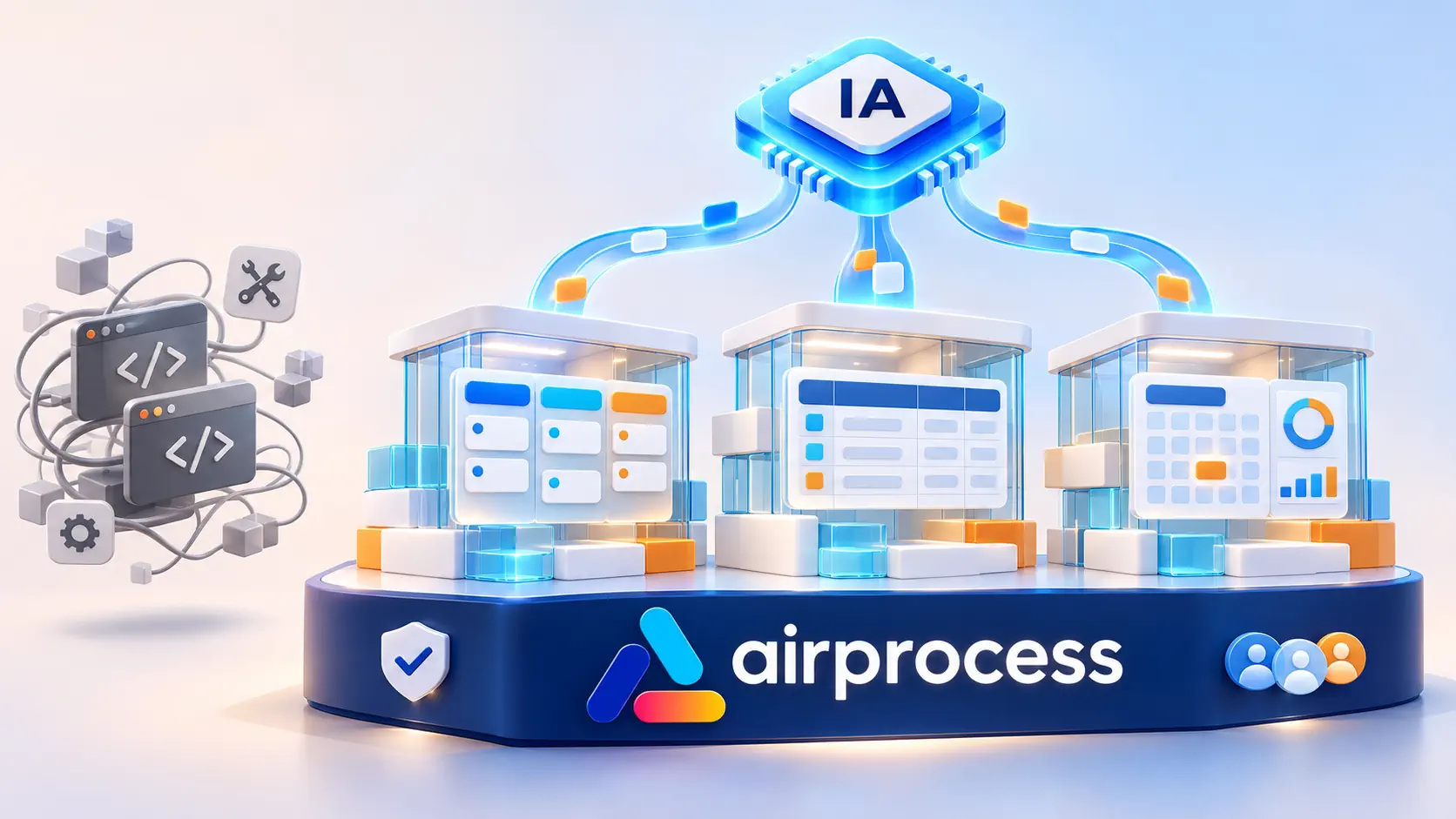
The hybrid approach relies on AI for analysis, data generation, and processing, and entrusts data management and interfaces to a standardized backoffice.
The idea is not to let AI code every new application, but to give AI superpowers by providing it with the backoffice, in order to obtain tailor-made, standard, solutions without increasing the amount of code.
AI handles smart tasks and complex processing, while Airprocess ensures data normalization, the creation of views on this data, and real-time collaboration mechanisms.
This duo offers a scalable, real-time collaborative, secure platform, easy to maintain, and capable of handling large volumes, but without writing new code for every need.
3.1. Airprocess Backoffice for Standardized Data
Concretely, in this logic, Airprocess serves as a standardized backoffice that receives and organizes the data generated by AI and NoCode flows, without coding for each new product.
Here is a concrete list of advantages to using Airprocess so you DO NOT redevelop the back-office of your application with AI:
- Forms can be designed via AI and/or via a drag & drop form builder by business teams to structure the data (customer records, files, projects, quotes, etc...).
- Native views offer components datatable, kanban, calendar, timeline, map and dashboard to structure information around a single schema. Here too, business users keep control by designing all views they need in their daily work. This approach eliminates the costs of rewriting code for each new view, and offers immediate scalability when new use cases appear.
- Operationally, Airprocess handles real-time collaboration, support for large volumes (views with tens of thousands of lines), security and access control, and data backups
- Airprocess also natively handles BPM workflows and business rules, enabling business users to be autonomous in defining their processes, in a simple way
- Document generation relies on standard DOCX templates (again, doable by business users themselves) and enables automatic PDF creation, their signing, and sending emails directly from a form.
- Public forms can collect external data (to capture requests from customers, prospects, partners, etc...)
- Public views can be made available to partners to share information without authentication
- Automatic document analysis can extract fields and populate records without manual entry (e.g., you attach an invoice to a form and the form auto-fills the fields).
- Online document editing (with versioning) and EuroOffice integration complete the ecosystem, all without writing additional code.
- Data can natively be exported to CSV, XLS, or JSON and reused in other systems, avoiding silos.
- etc...
Without listing all features, this provides a glimpse of everything you will not have to redevelop with your AI.
Thus, you obtain a backoffice capable of accommodating any type of data generated or processed by AI, while remaining no-code and extensible at the pace of your business needs.
4. Use Cases and Practical Adoption
For SMEs, adopting a hybrid approach "AI + Airprocess" allows quickly creating a robust backoffice solution without having to code anything.
4.1. Typical Use Case
In the commercial domain, a public form captures leads, AI analyzes them, classifies them, and proposes a sales action, while the data automatically feeds the customer file in Airprocess, generates the quote and the invoice in PDF format, and sends them by email.
In digital marketing, AI can prepare digital campaigns with all textual and graphical elements, then inject the result into Airprocess to manage the publication calendar, review and correction, and simultaneous sending to all social networks.
In procurement, order flows become traceable and reusable via CSV/Excel/JSON exports for accounting systems, without software duplication.
In documentation matters, AI extracts information from invoices and contracts, fills supplier and customer records, and triggers approval workflows.
The tool can also automatically generate documents from data merged into DOCX templates, convert them to PDF, and manage a signing workflow.
Finally, the backoffice offers all the power of native views (datatable, kanban, calendar, etc.) and fine data permissions.
This approach avoids the cost and fragility of AI-generated code for each new use case, while offering a unified, scalable, and compliant platform.
4.2. Performance Metrics and ROI
To measure the effectiveness of the hybrid approach "AI + Airprocess", one must define clear performance metrics and an ROI calculation over 12 to 24 months. The first indicator is the time to deploy new features and iterations: the total cycle from idea to deployment decreases when AI handles only the intelligence part and the standardized backoffice handles execution without bespoke development for each need.
The total cost of ownership (TCO) compares the cost of bespoke AI development and associated infrastructure with the recurring cost of Airprocess and integrations: for this, costs must be tracked by feature and data volume. One can also measure system performance: data volumes processed, latency, availability, and scalability for hundreds of thousands of rows.
To estimate ROI, we project net annual gains (maintenance reduction, productivity gains, reduction of errors and returns, etc.) and subtract upfront and recurring costs, and one can generally observe ROI within 12–24 months.
Today, after about 2 years of applying this "hybrid" model, we see real productivity gains and an obvious ROI with better-controlled AI usage among our clients.
If you want to test our approach or discuss it for your projects, book a meeting directly below!