

Does human resources management in your company feel like an obstacle course?
Between:
- recruiting new talent,
- onboarding employees,
- payroll management,
- time off
- and skills evaluation, each step can quickly become a source of complexity.
Do you dream of an organization where every HR action is smooth, where the employee experience is at the heart of your strategy, and where your HR team can finally focus on high-value tasks?
This is not a utopia!
This ultimate guide offered by AirProcess is the key to formalizing, simplifying, and optimizing every process.
Discover how to:
- define an effective method,
- use the right tools (maybe an HRIS?),
- and turn administrative management into a real performance lever for each employee and for the company.
Get ready to map your success and sustainably improve the operation of your HR department.
1) What is an HR process?
Before diving into the heart of the matter, let’s make sure we speak the same language.
An HR process is much more than a simple administrative formality.
It is the silent engine that sets the rhythm of your employees’ lives within the company.
But how do we define it precisely?
And why is understanding it well the first key to your success?
Let’s discover it together.
a) Definition: Beyond a simple task, a strategic vision for the company
An HR process is the set of actions and strategies of the HR teams, or a series of organized and repeatable actions,
These actions are designed to manage interactions between the organization and its employees, forming a sequence of well-defined and structured steps.
It consists of:
- the formalization of all actions,
- the steps
- and the tools used by your employees to implement the company’s strategy and support employees at each stage of their life cycle.
The key role of HR is to support the company's development and business by managing human resources to achieve objectives.
It actively contributes to employees’ fulfillment in order to increase the overall competitiveness of the company.
These processes can be considered essential business processes carried out by human resources.
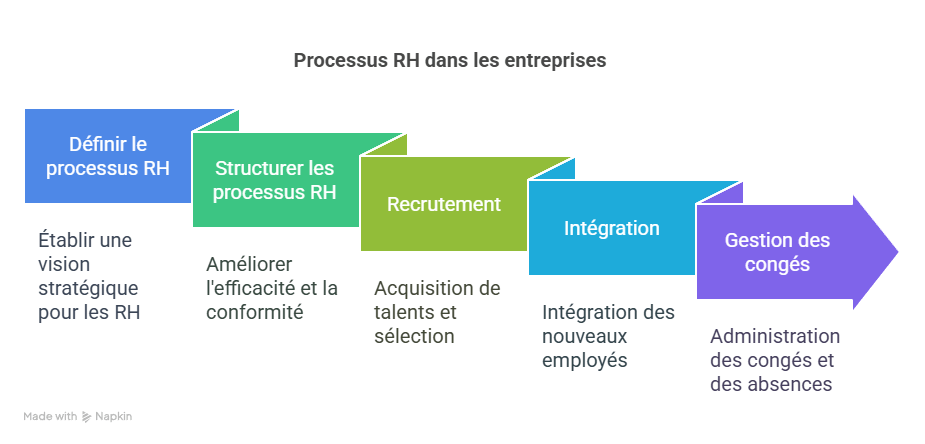
They cover the entire professional life of the employee, from recruitment, integration (onboarding), training, evaluation, promotion, to departure (offboarding).
Formalizing HR processes is essential for visibility, identifying problems, strategic alignment, and automation.
b) Why every company, small or large, MUST structure its HR processes
Implementing structured HR processes is essential for several reasons.
They improve operational efficiency by streamlining:
- human resources management operations,
- automating repetitive or low-value tasks,
- and freeing up time for strategic tasks.
These processes ensure legal and regulatory compliance by establishing consistent standards and practices and avoiding significant costs.
Good structuring can also help:
- reduce hidden costs by minimizing legal risks and operational inefficiencies,
- and prevent situations that clog up HR services.
They transform the company’s operation from "organized chaos to controlled flow" by offering a clear framework, allowing work methods to be reviewed and adjusted, and creating a common reference for teams.
Finally, a well-defined HR process guarantees fairness and transparency for each employee, improving the employee experience and strengthening trust by clarifying roles and responsibilities.
This need for structure applies to companies of all sizes.
c) Some concrete examples to illustrate: from recruitment to employee departure
HR processes are integrated into every key phase of working life in a company, from recruitment to employee departure.
The recruitment process is one of the most critical and important.
It is not just a simple selection, but a genuine talent acquisition strategy.
It covers:
- identifying staffing needs,
- writing and publishing job postings,
- processing applications,
- conducting interviews
- and evaluating candidates.
This process is important because it determines the quality of human capital that will join the organization.
You must optimize this process so that it is smooth, efficient, and fast, given the difficulties in finding the best candidates.
An employer must develop its employer brand to become attractive and attract talent.
The integration journey (onboarding) is a decisive step for retaining and engaging employees from day one.
It is the process of integrating new employees.
It includes welcoming, presenting the company and its policies, initial training on tools and procedures, and introductions to the teams.
Good onboarding, combined with management software, facilitates a smooth transition and can significantly improve talent retention.
It aims to make new hires productive and engaged from the start.
Listing the steps of onboarding helps avoid omissions and easily identify optimization opportunities.
Leave management is an example of an HR process related to personnel administration.
Although it may seem simple, this process is fundamental to the proper organization of the company.
Poor management of leave, absences, and working time can impact the whole team by complicating operational planning and reducing the impact on the value chain and customers.
Leave and absence management is a process that can advantageously be automated to save time and reduce errors.
It allows you to manage employees’ entitlements and balances and to have up-to-date schedules.
2) How to implement an HR process?
Now that the concept of an HR process is clear, a burning question arises: how do you go from theory to practice?
Implementing an effective HR process cannot be improvised.
It requires method, rigor, and a healthy dose of pragmatism.
Get ready to discover the key steps to build solid foundations for your human resources management.
It’s not rocket science, we promise!
a) The preparatory phase: laying the foundations of an effective management system
1) Identify the specific needs of your company and employees: needs analysis as a crucial starting point
For HR processes to fully contribute to the company’s development, they must be relevant and aligned with the company’s vision.
The first step is to list all activities that fall under the HR department to identify all activities necessary for the company’s development.
An analysis of the company’s targeted strategic positioning is fundamental to give meaning to HR choices.
You must analyze and integrate the needs of your employees by consulting employees directly.
Conducting an audit of your current practices allows you to:
- perform a complete inventory of all your HR activities,
- examine their effectiveness,
- identify redundancies,
- shortcomings
- and friction points encountered by employees or managers.
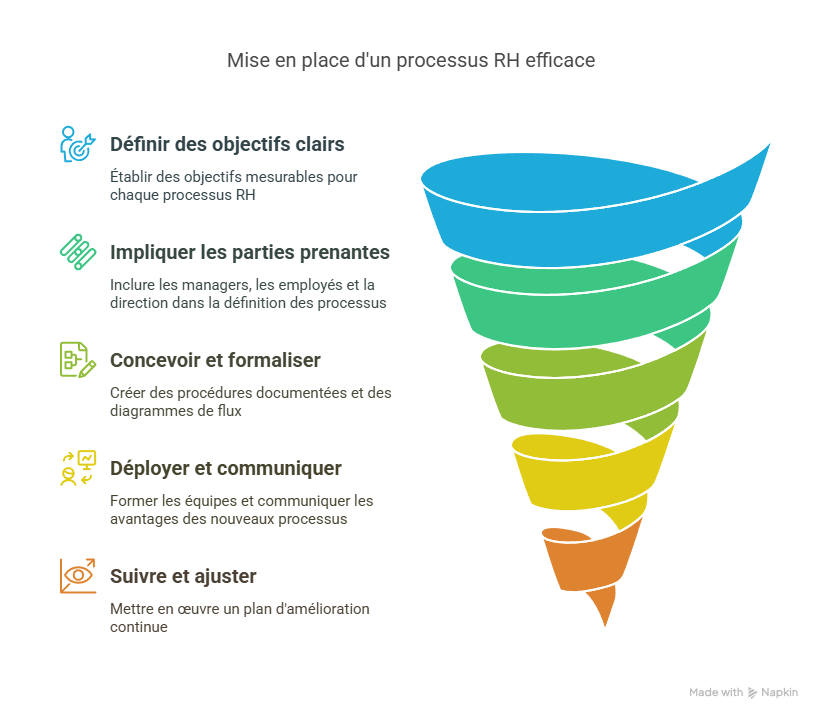
2) Define clear and measurable objectives for each HR process: what are we trying to improve or achieve?
HR processes increase the organization’s competitiveness and overall performance and contribute to employees’ fulfillment.
They make it possible to achieve strategic objectives.
Objectives include:
- developing and optimizing company operations,
- improving employee satisfaction and well-being,
- strengthening the employer brand to attract the best talent,
- adapting strategy,
- creating a corporate culture,
- improving administrative tracking
- and optimizing administrative management and HR procedures.
Therefore, you must define objectives for each process and establish key performance indicators (KPIs) to measure results.
3) Involve the right stakeholders: who are the key actors (managers, employees, leadership) in defining and implementing each process?
It is essential to involve your employees and to carry out this project with the company’s managers and staff in a co-construction approach.
Processes are more effective when created collaboratively.
You must involve key stakeholders such as:
- HR leaders and employees,
- as well as managers.
Bringing a team together in a workshop to formalize the process can be very useful.
b) Design and formalization: from idea to documented procedure
1) Map the existing process (if applicable) or create it from scratch: which method to choose to visualize each step?
Formalize all your HR processes while keeping the company’s vision in mind (top-down approach) and employees’ expectations (bottom-up approach).
HR process mapping is a simple method to define effective HR processes.
It allows you to:
- produce visual diagrams that help centralize data and interpret information,
- clearly visualize the different steps,
- the interconnections,
- each person’s roles,
- main tasks,
- events,
- the expected result and documentation.
Using flowcharts makes it possible to draw each step.
You can start by mapping processes, often by listing them in a table or modeling them graphically.
2) Write clear, concise, and actionable process sheets for each step: who does what, when, how and with which tools?
Developing a process offers the opportunity to review and adjust work methods.
You must define your processes with the company’s vision and employees’ expectations in mind.
Formalization involves precisely describing roles and key steps for each action, as well as the tools used and required validation processes.
You can go down to the level of sub-processes and define the steps, responsible parties, deadlines, inputs and outputs.
It is recommended to create process sheets, which are a tool to ensure the longevity of an activity and facilitate continuous improvement.
These sheets include key information such as:
- the mapping,
- performance indicators,
- the purpose,
- the objectives,
- the indicators,
- input/output data,
- major activities
- and more detailed procedures.
3) Integrate legal compliance (labor law, GDPR) and industry best practices from the design phase
HR processes must ensure good management and guarantee legal and regulatory compliance.
This is fundamental regarding the management of employees’ personal data, working conditions, and occupational health and safety.
HRIS tools, for example, comply with legal and regulatory obligations and can help anticipate these areas.
Ensuring a reliable and up-to-date database enables good administrative management.
Compliance is a topic that avoids considerable costs. You should rely on experts whose job it is.
HRIS tools can automate certain procedures to ensure compliance, such as archiving pay slips or alerts for required documents like driving licenses.
c) Deployment and communication: engage teams for successful adoption
Once HR processes are designed and formalized, the next step is their actual implementation within the organization.
This involves not only the technical deployment of tools (if applicable) but above all the human support to ensure adoption and maximize expected benefits.
1) Train employees and managers on the new HR processes: the importance of change management
Change management is a major HR objective.
It is essential to train the employees concerned so that they understand and implement the new processes.
This may include information sessions or the provision of resources such as guides or FAQs.
For an HRIS, for instance, employees need support throughout the digitization process.
Employees must clearly understand how the process works, their role, and how their work contributes to the company’s objectives.
Ensuring each employee has a clear view of their roles and resulting activities is important.
2) Communicate the added value and benefits for each employee and for the company
Good communication enables the success of a new HR process.
It is essential to communicate about the implemented processes, keeping in mind the goal of improving the employee experience and gaining clarity, efficiency, and speed for HR.
Communicate transparently about changes, explaining the reasons, advantages, and expectations.
For employees, process optimization can mean a better experience thanks to smoother, transparent procedures and easy access to information.
The company benefits from HR processes through increased efficiency and productivity.
Reducing low-value tasks frees up resources, which also promotes talent retention.
Regularly communicating progress, changes, and opportunities strengthens employee engagement.
3) Establish a monitoring and adjustment plan: the first version is never perfect. How to ensure continuous improvement?
HR processes must be measurable and adjustable.
Monitoring, evaluation, and continuous improvement are key steps.
You should define key performance indicators (KPIs) to measure results and monitor them regularly to assess effectiveness and make adjustments if necessary.
Collecting employee feedback allows processes to be continuously adjusted and improves acceptance.
Establishing open communication channels to gather comments and suggestions is important.
One method for continuous improvement is to encourage a culture where employees propose ideas to optimize processes and where those contributions are valued.
Regular reviews and evaluations help identify areas needing improvement.
Formalizing processes is a decisive tool to ensure the longevity of an activity and simplify improvement whenever necessary.
Auditing existing processes makes it possible to identify weaknesses and improvement opportunities, serving as the basis for diagnosis.
Critically evaluating existing processes helps identify those that are malfunctioning or sources of dissatisfaction in order to improve them.
Continuous improvement first requires the process to be modeled, after which user feedback ("bottom-up") can help optimize it.
3) Which HR processes exist in 2025?
The world of work is changing at lightning speed, and HR processes are no exception.
In 2025, some processes have become absolutely essential, while new priorities are emerging.
Are you up to date?
Let’s take stock of the HR processes that shape the employee experience and company performance today.
You might be surprised by their scope!
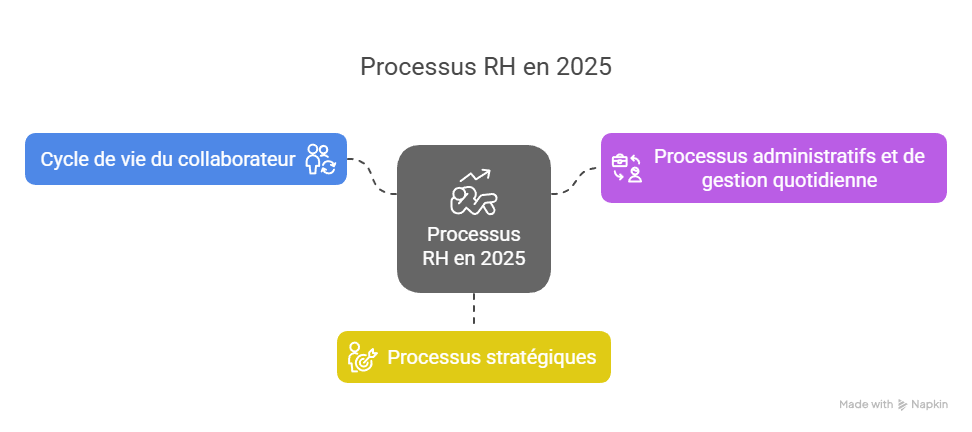
a) The employee life cycle: the essential processes that mark their journey
The entire professional life of an employee can be broken down into HR processes.
1) Recruitment and candidate selection processes
From needs analysis to drafting the job posting and selecting the best talent.
This is the process by which companies identify, assess, and select the most qualified candidates.
It is a critical process and a major HR objective.
It involves:
- defining needs,
- drafting job descriptions,
- publishing job offers,
- conducting interviews,
- checking references
- and making informed decisions to build a competent team.
Optimal management improves sourcing given the difficulties of finding the best candidates, so it is smooth, efficient, and fast.
It is important to communicate internally and externally to improve the employer brand.
The candidate experience is crucial to reduce job offer refusals.
Recruitment is part of the processes related to managing the company's human capital, along with performance evaluation and career management.
2) Onboarding new employees
Create a memorable and efficient experience (welcome kit, team introductions, follow-up during the first weeks).
This is the process of integrating new employees.
It includes:
- initial training on tools,
- company policies and procedures,
- and introductions to key teams.
Good onboarding facilitates a smooth transition and can improve talent retention.
It makes new hires productive and engaged from the start.
This includes a welcome kit, company presentation, and a mentoring system.
It is fundamental to support growth.
3) Career management and skills development
Annual reviews, training plans, internal mobility.
Career management and succession planning help reduce the risk of skills loss.
These processes focus on developing employees’ skills and their internal mobility.
They help align employees’ aspirations with the company’s needs.
This includes planning career paths, implementing training programs, and regularly evaluating skills and performance.
It is essential to have the skills required for company performance and to have an active, targeted approach to skills development.
Skills assessment and workforce planning (GEPP) are key processes.
4) Performance evaluation and goal tracking
A continuous dialogue for growth.
Performance management at the individual and team level is useful to align individual objectives.
Performance evaluation is a critical process that involves assessing and measuring employees’ performance and giving feedback to help them improve.
It is a crucial process for the company.
Annual review campaigns are part of these processes.
5) Offboarding
Care for the last impression, collect key information and handle administrative tasks.
Offboarding processes refer to all HR actions to be taken when an employee leaves.
This includes exit interviews, handling final payments, and transitioning responsibilities.
It is about taking care of the last impressions, for example through automatic sharing of official documents or an experience evaluation questionnaire.
b) Administrative and day-to-day management processes: the backbone of HR
1) Payroll and benefits management
Accuracy, punctuality, and salary compliance.
Payroll management and benefits administration are critical processes.
The salary review and payroll simulation process allows monitoring salary changes and bonuses.
This includes salary calculation, creating pay slips, legal compliance, and securing data.
Being legally and regulatorily compliant avoids considerable costs.
2) Time and absence management (leave, sickness, RTT)
An organizational and working-time compliance challenge.
Absence management is a fundamental process.
It includes managing leave entitlements and balances, and providing up-to-date schedules for managers.
This management enables operational planning and reduces impacts on the value chain.
It helps manage employees’ needs related to family life, such as half-day absences.
Having a dedicated tool reduces employees’ mental load and makes their life easier.
3) Personnel administrative management
From employment contracts to legal documents, ensure compliance.
This includes managing hires, departures, transfers, and processing changes to employees’ personal and professional information.
Administrative processes ensure compliance with current regulations.
Digitizing HR files and dematerializing the employment contract signing process improves the employee experience.
Personnel administrative management is a pillar of the HR function, alongside payroll and strategic HR processes.
c) Strategic processes for high-value HRM in 2025
In addition to life-cycle and administrative processes, some HR processes are becoming increasingly strategic for company performance and adaptability.
1) Talent management and succession planning
Identify and develop future leaders.
Talent management is considered one of the most critical HR processes.
It groups together processes related to managing human capital.
HR plays a key role in identifying, retaining, and developing talent.
This includes identifying high-potential employees and creating succession plans, as well as promoting internal mobility.
Managing careers and succession reduces the risk of skills loss.
Optimal management of talent processes and associated data helps identify the best potentials.
2) Employer branding development and employee engagement strategies
Strengthening the employer brand and the organization’s attractiveness are HR objectives to attract top talent.
A positive employee experience strengthens the employer brand and attractiveness.
When HR processes are efficient and modern, they "hit the mark" with employees, who become ambassadors for recruitment.
Improving the employee experience leads to better retention and company promotion.
Employee engagement is reinforced notably through training programs.
3) Continuous training and adaptation to new skills (upskilling/reskilling)
Training and development are major HR objectives.
Training processes form the backbone of any HR policy focused on skills development.
They encompass the entire training life cycle, from design to evaluation.
Effective management enables continuous development of employees’ skills, which drives engagement and performance.
You must have the skills needed for the company to perform today and tomorrow.
4) Optimizing quality of work life (QWL) and well-being
Processes for a healthy and motivating work environment.
Occupational health and safety are a priority for HR.
Employee well-being is an important issue.
Enabling teams to do their jobs well contributes to quality of work life.
Reducing employees’ mental load and making their lives easier through optimized tools and processes is part of this approach.
QWL is an important lever for employer attractiveness.
4) What are the benefits of automating HR processes?
Imagine a world where repetitive and time-consuming HR management tasks happen by themselves… or almost.
This world is no longer a utopia, thanks to automation!
But what are the concrete benefits to expect?
Time savings, cost reduction, better employee experience…
Automating HR processes is more than a technological trend; it’s a real revolution for your department.
Ready to discover how it can change your life (and that of your employees)?
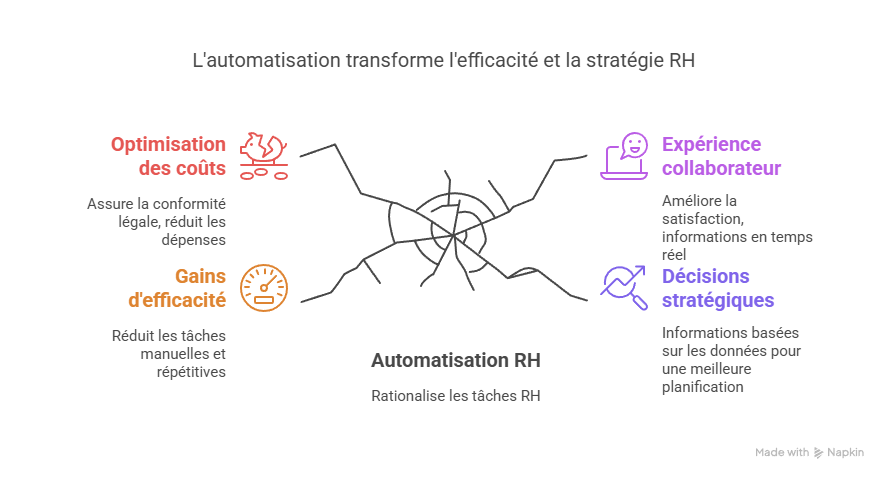
a) Efficiency and productivity gains: freeing up valuable time for people
Automating HR processes drastically reduces manual and repetitive low-value tasks such as:
- data entry,
- managing leave and absence requests,
- expense report management,
- or tracking applications.
It leads to faster validation flows and shorter processing times for requests, like signing an employment contract quickly, sometimes tripartite within a day.
Moreover, it enables a reduction in human errors and an improvement in the quality and reliability of HR data.
By automating these time-consuming tasks, HR teams can devote more time to high-value actions such as supporting employees, strategic employee development, or strategic initiatives.
Process optimization through automation helps simplify administrative management and follow-up.
b) Cost optimization and improved legal compliance
Automation is essential to ensure better traceability of actions and reinforced legal compliance.
Being compliant with regulations prevents considerable costs.
Automation guarantees compliance with legal and regulatory requirements in human resources management.
c) Impact on employee experience and strategic decision-making
Automation brings information to the employee in real time, easily and intuitively, offering faster responses and better tracking of employee requests, which improves satisfaction and well-being.
It helps simplify employees’ lives and reduce their mental load, notably by facilitating absence management, remote work, or advance payment requests via apps accessible at any time, even on weekends.
The transparency provided by access to information, such as pay slips in a digital safe or leave tracking, strengthens trust between employer and employee.
Improving the employee experience and better communication help reinforce the employer brand and attract and retain talent.
At the same time, automation and centralization provide reliable HR data accessible in real time, offering better visibility for leadership and enabling precise human capital management based on indicators and detailed analysis.
These data and this visibility illuminate the company’s strategy and help make decisions aligned with strategic objectives.
5) How to map HR processes?

"Mapping"… the word may sound intimidating, evoking complex diagrams.
Yet HR process mapping is an incredibly powerful exercise and often simpler than you think.
It is the art of making the invisible visible, of understanding where you are to better decide where you are going. So, how do you practically visualize your business processes and identify optimization levers?
Follow the guide; we explain everything step by step.
a) Why process mapping is a crucial first step for any optimization effort
HR process mapping, which is an essential element of human resources management, is a method that allows you to visualize clearly the different steps of a process, as well as the interconnections between these steps.
The main objective of this approach is to lay out each step, actor, and interaction of a process in order to obtain a clear and concise understanding of how it works.
By representing the operation schematically, mapping helps clarify everyone’s roles, simplify processes, and identify friction points.
It makes it possible to identify bottlenecks, repetitive or redundant tasks, inefficiencies, and pain points for employees and the HR team.
The information collected during the inventory and diagramming exercise is valuable for the needs analysis and problem identification.
Mapping also creates a common basis and standardizes procedures, ensuring uniform understanding of the process.
It is also a way to clarify HR processes and demonstrate the complexity and value of HR teams’ work.
b) Key steps for successful and actionable HR process mapping
To start establishing HR process mapping, it is recommended to carry out an inventory or audit of current practices, which constitutes the basis of the needs analysis.
Involving stakeholders, managers, and employees is essential, as they are often involved in the processes and know the field subtleties.
The first step is to define the scope, that is, which HR processes to identify and map, ideally starting with those that are most critical, have the most impact, or are dysfunctional.
You must then identify all the steps of the process, including:
- inputs and outputs,
- as well as the actors or roles involved (who does what?),
- information flows,
- tools used and decision points.
You must choose the right method and the appropriate level of detail for your mapping.
Using a flowchart or swimlane diagram allows you to visualize the steps and their interconnections.
Modeling tools can help create a structured repository, but starting with a simple diagram, even handwritten or in a spreadsheet, can be sufficient at first.
The important thing is that the representation be easily understood by all parties concerned.
Once the diagram is created, it must be analyzed to identify blockage points and inefficiencies, which will then allow improvements to be proposed and the target process to be modeled.
Monitoring these optimized processes can then be facilitated by using dashboards.
c) From mapping to action: how to use this analysis to improve and optimize your processes
Once the HR process mapping is established, the next step is in-depth analysis to turn observations into concrete actions.
Analysis of the HR mapping reveals immediate improvement opportunities: simplify complex steps, automate repetitive tasks, and clarify ambiguous roles and responsibilities.
Identifying friction points, bottlenecks, delays or frequent errors highlights the critical areas requiring intervention.
It is then essential to prioritize optimization projects for HR processes based on their strategic impact, criticality, level of dysfunction (are they malfunctioning?), and feasibility.
This prioritization concentrates efforts where they will bring the greatest benefits.
Finally, mapping is not an end in itself, but a living reference document.
It should be used to communicate changes, train newcomers (facilitating onboarding), and above all, for the monitoring and regular evaluation of implemented improvements.
By measuring results using key performance indicators (KPIs) and collecting employee feedback, mapping becomes a powerful tool for continuous improvement.
6) Which tools to manage HR processes?

You have defined, implemented, and even mapped your HR processes.
Well done!
But to shift into high gear, especially with automation, the right tools are indispensable.
The market is full of solutions, from comprehensive HRIS to specialized software.
How do you navigate this technological jungle and choose the tool that truly matches your needs and company size?
Don’t worry, we break it down for you.
a) HRIS (Human Resource Information System): the integrated solution for centralized management
The HRIS is defined as a human resources information system that manages employees from A to Z.
It is an all-in-one platform composed of numerous HR functionalities.
In 2024, an HRIS is expected to offer key features covering the entire employee life cycle.
This includes:
- personnel administrative management (entries, exits,
- transfers,
- changes of information,
- digitized HR files),
- payroll management,
- recruitment (application management, interviews) and onboarding,
- talent management (performance, skills, careers, reviews),
- training (management, catalog, budget tracking, evaluations),
- absence and leave management,
- time and scheduling management,
- expense report management,
- electronic document signing,
- or remote work management.
A good HRIS also offers HR dashboards to track key indicators and make informed decisions.
The advantages of an HRIS platform are multiple.
It enables centralization of all personnel data in a single reliable database.
The main asset is often the ability to automate repetitive and time-consuming tasks.
The HRIS improves:
- efficiency,
- productivity
- and data accuracy.
It ensures consistency and standardization of processes and helps guarantee legal and regulatory compliance.
For employees, it improves the experience by offering transparent processes and easy access to information via a dedicated portal.
When choosing an HRIS, several points deserve attention.
Modularity is essential to adapt the solution to the company’s needs and deploy it in stages.
Integration capacity with other existing software is also important.
Finally, the user experience (UX), for HR teams as well as employees, is crucial to ensure adoption of the tool.
A tool that is easy to use, even for complex processes, facilitates ownership.
b) Specialized software: expert tools for specific and advanced HR needs
Beyond integrated HRIS, the market offers a multitude of specialized software designed to cover specific HR processes with expert functionalities.
Notably:
- ATS (Applicant Tracking Systems),
- dedicated to recruitment,
- LMS (Learning Management Systems),
- for training management and e-learning course creation,
- time and activity management software (GTA),
- performance evaluation tools,
- document management systems (DMS) for digitizing files,
- business process management (BPM) or workflow software, or outsourced payroll solutions.
Opting for a specialized tool rather than an integrated HRIS module can be relevant in certain use cases.
If an HR need is very specific or requires particularly expert functionality not fully covered by the generalist HRIS module, a dedicated solution may perform better.
Some companies may also prefer a "best-of-breed" approach by choosing the best tools for each function.
The major challenge with multiple specialized tools is interoperability.
You must ensure that your various software communicate effectively to avoid data silos and double entries.
Integrations or APIs make it possible to connect these solutions to streamline information flows and maintain coherent HR process management.
c) How to choose the right tools for your company and optimize your HR processes?
1) A fine analysis of your current and future needs: don’t be seduced by useless features
Choosing the right software or platform to optimize your HR processes requires a rigorous methodology.
The first essential step is a detailed analysis of your current and future needs.
This analysis, ideally conducted in co-construction with managers and employees (future tool users), helps understand their expectations and working methods.
It will prevent you from being seduced by unnecessary features that do not match your real needs and will allow you to tailor the solution.
The analysis must also take into account the company’s strategic positioning.
2) Define a realistic budget and evaluate the expected ROI (return on investment)
You must define a realistic budget and evaluate the expected ROI for each process optimization project.
3) The importance of vendor support: training, technical support, updates
The support offered by the vendor or integrator is a key success factor.
This includes training HR teams and employees to use the software, technical support in case of issues, and guaranteed regular updates to remain compliant with legal and regulatory changes.
Relying on experts for tool implementation is recommended.
7) How to improve the employee experience with HR processes?
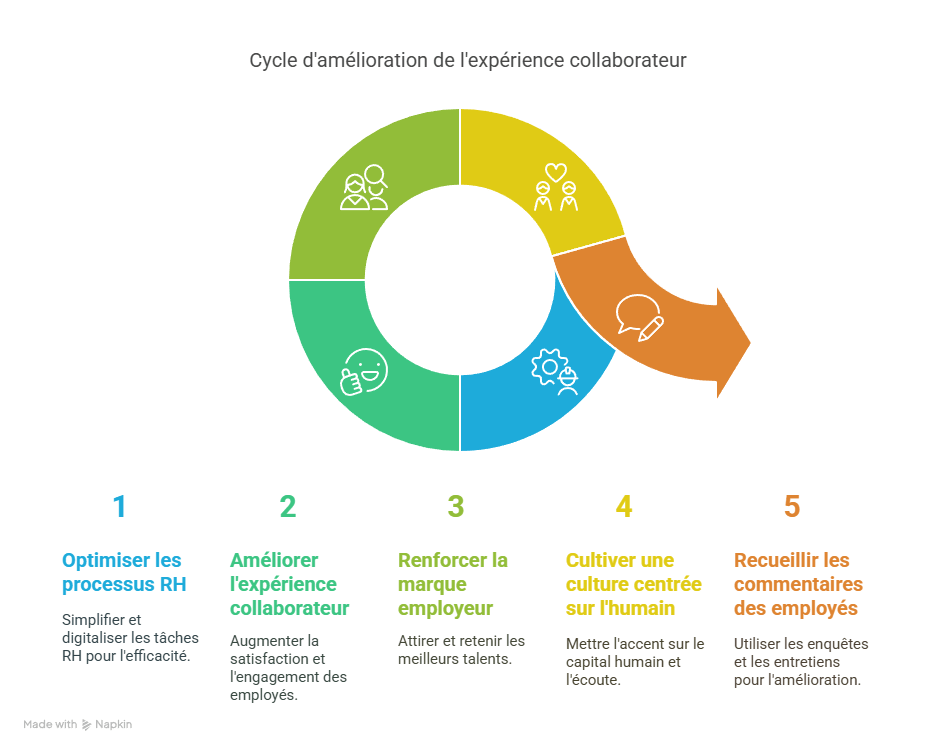
What if the key to an exceptional employee experience was (also) hidden in your HR processes?
Often perceived as purely administrative, they actually have a direct daily impact on every employee’s experience.
From onboarding to career development, including the simple leave request.
So, how do you turn these steps, sometimes sources of friction, into real levers of engagement and satisfaction?
That is the challenge we will address together.
a) The inseparable link between smooth HR processes and a positive employee experience
Many operational staff experience HR processes as an additional constraint on their workload, without perceiving the added value.
Poorly designed, slow, or opaque processes can become a source of frustration and disengagement for employees.
The annual review exercise, for example, can quickly become tedious if it is reduced to an annual formality without meaningful interaction.
Similarly, absence management or material management associated with a position can generate mental load if processes are not smooth.
Conversely, smooth, transparent, and simple processes are perceived as efficient and modern, contributing to employees’ well-being and fulfillment.
Turning every HR interaction—be it a request, a piece of information, or a follow-up—into an opportunity to strengthen trust and demonstrate HR’s added value is essential.
When employees see that HR processes are efficient and modern, it strengthens the employer brand.
A strong employer brand, nurtured by a positive employee experience, is fundamental to attract and retain top talent.
Satisfied employees even become the company’s best ambassadors.
b) Concrete levers so your HR processes really serve the employee experience
Optimizing HR processes aims to increase efficiency and performance by freeing up time for HR teams to focus on high-value human support.
One lever is to simplify and digitize routine requests for more autonomy and responsiveness.
Concrete examples include:
- self-service leave management,
- easy access to personal documents
- or digitized pay slips in a digital vault.
These tools directly help quality of work life by reducing employees’ mental load.
You must personalize journeys, especially during onboarding or for career development and internal mobility.
Adaptable and flexible HR processes make it possible to consider employees’ individual needs and aspirations.
Involving employees in the design and optimization of processes, through co-construction or "bottom-up" feedback, ensures they meet expectations.
Transparent internal communication throughout these processes strengthens engagement and trust.
Finally, making information on skill development opportunities accessible (such as a digital training catalog) can strongly stimulate employees’ interest and engagement in their professional development.
c) Beyond processes: cultivating a company culture centered on human capital and listening
Improving the employee experience is not limited to optimizing administrative steps; it also means cultivating a company culture that truly places human capital at the heart of its strategy.
The crucial role of the frontline manager is therefore fundamental.
Managers are involved in many HR processes, such as evaluation, mobility, training, or recruitment.
They can even be designated as process owners.
Their daily human support is essential for process fluidity and team support.
Well-designed HR processes can actively support a quality of work life (QWL) policy and employee well-being.
By reducing mental load and providing the means to do their jobs well, these processes directly contribute to improving working conditions and the balance between professional and personal life.
To achieve this, it is essential to use employee feedback (surveys, interviews) for continuous improvement of your HR processes, adopting a user-centered design thinking approach.
This agile and iterative method helps understand employees’ needs—physical, cognitive, and emotional—to create intuitive, high-value solutions.