
Are you looking to know how to continuously improve your processes, products and services, but don’t know where to start?
Then you are in the right place at the right time!
In this complete guide you will learn :
- What continuous improvement is and why it matters in BPM.
- The fundamental principles of continuous improvement.
- How methodologies like Kaizen, Lean and Six Sigma can be applied.
- Continuous improvement tools such as the PDCA cycle, the 5S method and Kanban.
- Concrete case studies and success examples.
By the end of your reading, you will be able to :
- Understand the basics of continuous improvement and its application in BPM.
- Implement methodologies and tools to improve your processes.
- Use AirProcess to automate and optimize your workflows.
So, without further ado, let’s start with a definition of the subject and dive into the world of continuous improvement.
1) Introduction to Continuous Improvement
a) What is continuous improvement and why is it essential in BPM?
Continuous improvement is an approach that enables the optimized management of your processes, products and services.
This concept is important in Business Process Management (BPM) and allows you to constantly adjust and improve your operations in order to maximize value creation internally.
b) What are the fundamental principles of the continuous improvement approach?
Fundamental principles include employee engagement, customer focus, and the use of data for decision-making.
The Kaizen method, for example, encourages employees at all levels to propose improvements in their daily work.
Lean Management focuses on eliminating waste to increase efficiency and quality.
Using tools like Kanban boards allows you to visualize tasks and identify bottlenecks in processes.
c) How does continuous improvement differ from other management strategies?
Unlike management strategies that focus on major, one-off reforms, continuous improvement advocates incremental and constant changes.
This approach allows you to create a culture of ongoing improvement where every small change helps optimize your performance day by day.
For example, a company can implement minor adjustments on the production line to reduce downtime and optimize the deployment of productivity without disrupting the entire system.
d) What are the historical origins of continuous improvement?
Continuous improvement has its roots in Japanese management practices after World War II, notably with Toyota which introduced the concept of Kaizen.
Since then, these practices have been widely adopted and adapted by various industries around the world.
As a result, Toyota’s success in producing high-quality cars at reduced cost has served as a model for many companies.
e) Why is continuous improvement particularly relevant in today’s business context?
In a context marked by intense competition and growing customer expectations, continuous improvement is more relevant than ever.
For example, with the emergence of digital technologies, you can use no-code platforms like AirProcess to create and quickly adjust your workflows, enabling rapid adaptation to new market requirements.
2) The role of BPM in continuous improvement
a) What is business process management (BPM)?
BPM allows you to map, model, automate, monitor and optimize workflows to increase efficiency, flexibility and the quality of products and services.
In fact, BPM ensures consistent and agile management of business processes.
b) Why is BPM important for modern companies?
For example, in an environment where digital transformation is paramount, BPM helps integrate advanced technologies, such as no-code platforms, to automate and optimize processes without requiring coding skills.
c) How does BPM support continuous improvement initiatives?
BPM supports continuous improvement initiatives by providing a clear structure for analyzing, measuring and optimizing processes.
By using PDCA cycles (Plan-Do-Check-Act), you can plan improvements, implement them, verify the results achieved, and adjust processes accordingly.
3) Methodologies and tools for continuous improvement
a) What are the main methodologies?
The main continuous improvement methodologies include Kaizen, Lean Management and Six Sigma.
- Kaizen focuses on incremental daily improvements, involving all employees in the optimization process.
- Lean Management aims to eliminate waste and improve efficiency by focusing on value added for the customer.
- Six Sigma uses statistical tools to reduce process variability and eliminate defects, driving the continuous improvement of quality.
b) How do Lean and Six Sigma methodologies fit into BPM?
Lean and Six Sigma methodologies integrate perfectly into Business Process Management (BPM) by providing structured frameworks for process analysis and optimization.
Lean Management, for instance, allows you to map business processes to identify and eliminate waste, while Six Sigma brings analytical rigor to reduce variation and improve quality.
Together, they help companies create more efficient processes and maintain a culture of continuous improvement.
c) What BPM tools can be used?
Various tools can be used to support continuous improvement.
Process diagrams help visualize and understand workflows, while Kanban boards facilitate task management and activity prioritization.
Thus, BPM software such as AirProcess allows you to create, track and optimize custom workflows without requiring coding skills, making processes more adaptable and responsive.
d) How is the PDCA (Plan-Do-Check-Act) cycle applied in BPM?
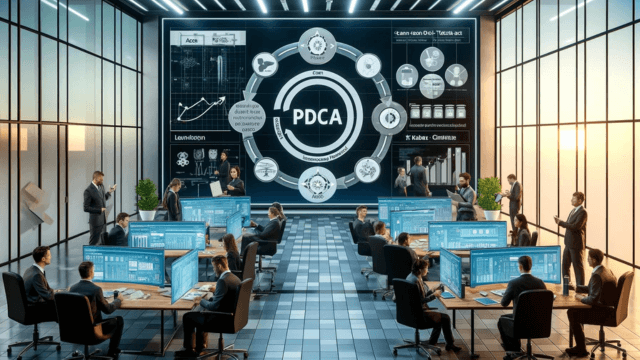
The PDCA (Plan-Do-Check-Act) cycle is an iterative management model used for control and continuous process improvement.
Within BPM, PDCA starts with :
- Planning improvements (Plan).
- Implementing solutions (Do).
- Verifying the results achieved (Check).
- Adjusting processes based on feedback (Act).
If you wish, you can use the PDCA cycle to test new quality management approaches, assess their effectiveness and adjust methods accordingly.
e) What are the benefits of using Kanban boards in continuous improvement?
In fact, Kanban boards offer several advantages.
They allow you to visualize the workflow and tasks in progress, which makes it easier to manage priorities and identify bottlenecks.
Therefore, if you use Kanban boards, your teams will be able to track project progress in real time and make immediate adjustments if necessary.
Thus, if you work in software development and want to use Kanban boards, they can help you manage sprints and ensure continuous delivery of high-quality features.
4) Continuous improvement tools
a) The Deming wheel or PDCA cycle
The Deming wheel or PDCA cycle is a structured continuous improvement tool composed of four steps: Plan, Do, Check and Act. It is called a “wheel” to emphasize the cyclical nature of the process.
b) The 5S method
Initially implemented by Toyota in its factories in Japan, it is based on five actions:
- Sort (Seiri)
- Set in order (Seiton)
- Shine (Seiso)
- Standardize (Seiketsu)
- Sustain (Shitsuke)
This method improves various aspects such as working conditions, movement and productivity, while reducing accidents, information loss and equipment degradation.
c) The Six Sigma method
Method invented by Motorola, based on indicators and customer feedback.
It follows the DMAIC model (Define, Measure, Analyze, Improve and Control).
Although initially intended for industry, it is now applied across various sectors.
d) The Just-in-Time method
The “just-in-time” method, also known as the “5 zeros” or “tight flow”, links production to demand rather than to supply.
It aims to improve logistical efficiency, reduce unnecessary inventory and waste, while increasing product quality.
e) The Kanban method
The Kanban method, widely used in IT, allows dynamic and visual management of production and supply flows.
Used together with “just-in-time”, Kanban uses cards (or “tags” in Japanese) to represent tasks to be done, in progress, or completed.
f) The quality circles approach
The quality circles approach, developed by Kaoru Ishikawa, emphasizes quality management by the people directly concerned.
Bringing together 3 to 10 people, these circles solve problems through collective intelligence and increase participant engagement.
5) Use cases
a) How can continuous improvement improve human resources management?
It can significantly optimize human resources management by streamlining recruitment, training and performance management processes.
If you apply methodologies such as Lean and Six Sigma, you can identify issues in your HR processes and implement corrective actions.
In practice, a Lean recruitment process could reduce hiring times by eliminating redundant steps and automating certain administrative tasks.
b) What are examples of continuous improvement success in production?
In the production sector, many success stories demonstrate the positive impact of continuous improvement.
For example, Toyota used Kaizen to reduce downtime and increase productivity on its assembly lines.
Similarly, if you are an electronics manufacturer you can apply Six Sigma to reduce defect rates and improve your product quality.
c) How can service companies benefit from continuous improvement?
Service companies can benefit by optimizing their operational processes to provide a better customer experience.
This example can apply to a financial services company that could use BPM tools to improve the handling of customer requests and reduce file processing times.
d) What are common challenges when implementing continuous improvement?
Common challenges include :
- Resistance to change.
- Lack of employee engagement in their work roles.
- Difficulty maintaining motivation (mindset) over the long term.
Therefore, to overcome these obstacles, you must clearly communicate the benefits of continuous improvement, involve employees at all levels, and finally recognize and reward people who actively participate in the project.
A good practice would be to organize training and awareness sessions to help establish a culture of continuous improvement in the company.
6) The concrete benefits of continuous improvement
Continuous improvement promotes employee engagement and accountability by involving them directly in the optimization process.
Therefore, if you use tools like Kanban boards and the PDCA cycle (Plan-Do-Check-Act), your teams will be able to visualize their tasks, prioritize their efforts and quickly identify obstacles to productivity.
7) Implementing continuous improvement
a) How did companies like Toyota use continuous improvement to become industry leaders?
Toyota used this concept to become a leader in the automotive industry by implementing the Toyota production system (TPS).
This system integrates principles from Lean Management and Kaizen to eliminate waste and improve the efficiency of processes.
Thanks to this approach, Toyota succeeded in producing high-quality vehicles at lower cost, allowing it to set high standards in the automotive industry.
b) How can small and medium-sized enterprises take advantage of continuous improvement?
For example, an SME in the manufacturing sector can use PDCA cycles to test and gradually improve its production processes, enabling increased efficiency without requiring major investments.
Additionally, no-code platforms like AirProcess allow SMEs to easily create and customize workflows to support their continuous improvement initiatives.
8) Integrating AirProcess into the project
a) You benefit from the flexibility and customization of No-Code
To succeed in your project, you must be able to quickly adapt your business processes without relying on complex IT developments.
AirProcess, with its no-code platform, allows you to create and modify workflows in minutes, ensuring maximum flexibility.
b) Improvement and performance tracking tools available
AirProcess offers a full range of tools to measure and analyze process performance.
Features such as custom views, multi-level groupings, and advanced filters allow you to track key performance indicators (KPIs) in real time.
For example, by using progress bar and rating fields, managers can visualize project progress and quickly identify areas that need improvement.
c) Collaboration and problem solving
Continuous improvement relies on employee engagement and cross-team collaboration.
Therefore, AirProcess facilitates this collaboration with its task tracking features.
Your teams can define workflow steps, assign roles and track decisions, ensuring smooth communication and fast problem resolution.
For example, in an HR management context, AirProcess can help structure the recruitment and training process, ensuring continuous improvement of employee skills.
d) Integrating Lean and Six Sigma methodologies
If you adopt Lean and Six Sigma methodologies, AirProcess provides the necessary tools to implement these approaches effectively.
Indeed, features such as diagrams, Kanban boards and internal audit reports allow you to visualize workflows, identify waste and optimize your processes.
9) The role of the interim manager.
a) The role and benefits of an interim manager to initiate and structure continuous improvement projects
To initiate and structure continuous improvement projects, the role of an interim manager is key.
They bring temporary but highly specialized expertise to diagnose the current situation, propose innovative solutions and implement action plans.
The necessary qualities and Lean Six Sigma certification levels for these managers
Necessary qualities for an interim manager include deep expertise in Lean Six Sigma and an ability to lead teams across functions.
Certifications such as Yellow Belt, Green Belt, Black Belt and Master Black Belt in Lean Six Sigma are often required for these roles.
These certifications ensure mastery of the tools and methodologies needed to drive continuous improvement initiatives.
For example, a Master Black Belt certified interim manager can lead complex projects involving multiple sites, ensuring consistency and standardization of continuous improvement practices at scale.
Concrete examples of the impact of an interim manager in demanding sectors such as aerospace or automotive
The benefits of using an interim manager include an objective approach and the ability to quickly deliver tangible results.
In aerospace, for example, an interim manager can significantly reduce production cycle times by applying lean methods while maintaining the strict quality and safety standards of this sector.
This results not only in improved operational performance but also in better customer satisfaction thanks to shorter delivery times and optimized product quality.
10) Sustaining and making continuous improvement durable
a) How to ensure sustainability of implemented actions?
To sustain achieved improvements, you must implement rigorous tracking and control systems.
This includes using performance indicators to measure improvement effectiveness and conducting regular reviews of processes.
For example, a manufacturing company can use regular internal audits to verify compliance with ISO standards and ensure new practices are maintained.
Documenting processes and changes is also essential to ensure knowledge and improvements are properly transferred throughout the organization, and a platform like AirProcess can also help at this level.
b) What mechanisms should be put in place for regular process reviews?
Setting up mechanisms for regular process reviews will allow you to identify opportunities.
This may include weekly or monthly meetings where teams review process performance, discuss encountered issues and propose solutions.
c) How to use employee feedback to feed the project?
Employee feedback is a valuable source of information.
Therefore, you should encourage a culture of open communication where employees can share their ideas and core concerns.
Then use AirProcess to collect and analyze feedback through its customizable forms.
For example, you can create regular surveys to gather suggestions for improvement from your employees, allowing you to detect problems quickly and implement effective solutions.
d) What are the signs that a process needs to be reevaluated and improved?
Several signs can indicate that a process should be reevaluated and improved, including increasing costs, declining product or service quality, frequent delays or recurring customer complaints.
Analysis of key performance indicators (KPIs) helps spot these issues.
If you are a logistics company and observe an increase in delivery times and transportation costs, this may signal the need to review and optimize your logistics processes.
e) How to integrate regular audits into your strategy?
Integrating regular audits into your strategy ensures compliance and helps identify improvement opportunities.
These audits can be internal or carried out by external organizations and should be scheduled to cover all aspects of operational processes.
For example, an ISO 9001 certified company must perform regular internal audits to ensure its quality management systems are effective and compliant with standards.
11) Quality circles
Quality circles are a participatory method developed by Kaoru Ishikawa that allows employees at all levels of the company to meet and collectively identify and solve problems.
These circles typically bring together between 3 and 10 people who voluntarily work together to propose concrete improvements in their respective areas.
a) Advantages of quality circles
Quality circles foster collective intelligence, allowing you to benefit from ideas and perspectives from multiple employees.
By directly involving the people concerned by the problems, this method improves team engagement and motivation.
Moreover, it contributes to better communication and a deeper understanding of internal processes.
b) Examples of successful implementation
In the automotive industry, Toyota is often cited as a success story with the use of quality circles.
Toyota employees regularly meet to discuss issues encountered on the production line and propose innovative solutions to improve efficiency and quality.
This approach has allowed Toyota to reduce defects and optimize production processes, strengthening its position as a market leader.
c) Implementing quality circles
To implement quality circles, it is important to follow a few key steps.
First, identify volunteers among employees and form homogeneous groups.
Next, organize training sessions to introduce them to problem-solving techniques and continuous improvement tools.
It is also essential to define clear and measurable objectives for each quality circle.
Management must actively support the circles by providing necessary resources and recognizing members' contributions.
This can be done through rewards or public recognition of achieved successes.
Finally, you should maintain open and regular communication to monitor the progress of initiatives and evaluate their impact on the organization.
12) Monitoring and evaluation
a) What are the most effective evaluation tools to measure the impact of continuous improvement?
Effective evaluation tools include :
- Performance dashboards.
- Internal audits.
- BPM software such as AirProcess.
Dashboards allow KPI visualization in real time, facilitating data-driven decision making.
Internal audits, for their part, provide qualitative assessment of processes and identify gaps relative to established standards.
AirProcess, with its reporting capabilities, offers detailed analyses to track and measure the impact of initiatives.
b) How can AirProcess provide reports and analyses to support your continuous improvement initiatives?
AirProcess provides detailed reports and analyses thanks to its tracking and reporting features.
Users can create custom dashboards to visualize relevant KPIs, generate automated reports on process performance, and analyze collected data to identify trends and improvement opportunities.
For example, a manufacturing company can use AirProcess to track non-conformities, analyze root causes and implement corrective actions, while monitoring the effectiveness of the solutions put in place.
13) Other avenues to explore
a) Adopting McKinsey’s 7S for a holistic analysis of the company
To get an overview of internal performance and structure efforts, adopting the McKinsey 7S model can be a good option.
This model, developed in the 1980s, examines the seven key aspects of the organization below :
- Strategy.
- Structure.
- Systems.
- Management style.
- Skills.
- Staff.
- Shared values.
If you apply the 7S, you can identify areas that need improvement and ensure that all elements of the organization are aligned and work coherently.
b) Using the QQOQCCP method to diagnose and solve problems
The QQOQCCP method (Who? What? Where? When? How? Why?) is a powerful tool for data collection and problem solving.
By asking these questions, you can accurately diagnose dysfunctions and design appropriate solutions.
For example, a QQOQCCP analysis of delivery delays can identify exact causes, such as poorly synchronized production processes, and enable targeted corrective actions.
c) Implementing the Gemba approach for on-site improvement
The Gemba approach consists of observing processes directly on the ground to identify inefficiencies.
By going to their workplace, managers can see problems in real time and understand the difficulties employees face.
This method fosters continuous improvement, as it reveals improvement opportunities often invisible from an office.
For example, observing production line operations can reveal unnecessary steps or bottlenecks that can be eliminated.
d) Applying Pareto’s law in process management
Pareto’s law, or the 80/20 principle, suggests that 80% of results come from 20% of efforts.
By applying this law, companies can focus their continuous improvement efforts on actions with the greatest impact.
e) Solving problems with the 5 Whys method
The 5 Whys method is a simple but effective technique to uncover root causes of problems.
By asking “Why?” five times in a row, companies can go beyond symptoms and address underlying causes.
For example, if a defective product is discovered, asking “Why?” at each response may reveal that the problem stems from inadequate staff training, which can be corrected by additional training sessions.
f) Strategic alignment with Hoshin Kanri
Hoshin Kanri is used to align the company’s strategic objectives with daily operational activities.
By deploying this method, companies can ensure that all levels of the organization are working toward common goals.
g) Eliminating the 3M to optimize processes
The 3M (Muda, Mura, Muri) are key concepts in lean management representing waste, variability and overload respectively.
By eliminating these three sources of loss, companies can improve their operational efficiency.
For example, identifying and eliminating Muda (waste) in a production process can reduce costs and increase product quality, while eliminating Mura (variability) and Muri (overload) can improve the regularity and reliability of operations.
h) Adopting the VUCA approach
The VUCA approach helps better anticipate and adapt to rapid market changes.
For example, by integrating agile methodologies, companies can react quickly to new opportunities and adjust their processes according to market developments.
Training teams in flexibility and adaptability is essential to maximize the benefits of this approach.
i) Applying Gleicher’s change formula
Gleicher’s change formula is a valuable tool to structure continuous improvement initiatives and manage resistance to change. Here is the formula:
C=(D×V×F)>R, with :
- C representing the desired change (Change)
- D representing dissatisfaction (Disatisfaction)
- V the vision of an improved future (Vision)
- F the first steps to take (First steps)
- R is resistance to change (Resistance)
If you develop a clear vision of the future and identify concrete actions from the start, you can engage your teams more effectively so that Vision and First steps outweigh Resistance to change.
j) Setting up a network of facilitators
These facilitators, often trained managers, help manage the additional workload and maintain employee engagement.
For example, a company can train managers to become continuous improvement facilitators, providing them with tools to help teams free up time for new improvement activities.
This network helps streamline the implementation of initiatives and ensures that improvement efforts are well integrated into daily work routines.
k) Using the “Give me 5” concept
The “Give me 5” concept offers a structured method to validate continuous improvement initiatives based on their complexity and the time required to complete them.
This progressive validation system, ranging from 5 minutes to 5 months, allows efficient prioritization of projects.
For example, an initiative requiring 5 minutes can be quickly approved by the employee, while a 5-month project requires approval from the management committee.
This approach facilitates quick decision-making for short-term projects and ensures appropriate resource management for more complex initiatives.
14) Conclusion
Continuous improvement, essential in Business Process Management (BPM), relies on principles such as employee engagement, customer focus and the use of data for decision-making.
Methodologies like Kaizen, Lean Management and Six Sigma play an important role in eliminating waste and improving process efficiency and quality.
BPM tools, such as AirProcess, facilitate workflow automation and optimization, strengthening continuous improvement initiatives.
In today’s context where competition is fierce and customer expectations are high, continuous improvement proves more relevant than ever.
It enables companies to adapt quickly to market changes and maintain optimal performance.
By adopting a culture of perpetual improvement, organizations can not only survive but thrive in a dynamic environment.
To deepen your understanding and discover practical tools to implement continuous improvement in your company, we invite you to explore our other articles and resources available on our site.
Which processes in your organization could benefit from a continuous improvement approach, and how could you start optimizing them today?
By asking yourself this question, you initiate a personal reflection that can lead to concrete actions to improve performance and quality within your company.
FAQ
1) What types of improvement are there?
Improvement areas include time management, organizational capabilities, ease of delegating tasks, as well as interpersonal and communication skills.
2) What is an improvement action?
An improvement action aims to carry out continuous and sustainable initiatives to optimize all company processes by eliminating dysfunctions and strengthening value-creating assets.
3) How to measure continuous improvement?
Continuous improvement can be measured using several key indicators: safety, costs, product quality, overall equipment effectiveness (OEE), time savings, customer satisfaction, return on investment (ROI) and employee satisfaction.
4) Who is responsible for continuous improvement?
The person responsible for continuous improvement, often called the Lean Manager, is generally a professional tasked with improving the overall performance of organizations; however, in very small businesses this should come from the owner(s) or leaders.
Note that we can support you in this approach.
5) How to propose improvements?
During sessions, it is useful to clearly explain improvement suggestions with concrete examples.
It is important to remove the stigma from raising comments, reminding that the goal is not to denounce or punish, but to improve practices.