

What if your bank could turn every challenge into an opportunity for growth?
In the banking sector, process complexity, high customer expectations, and regulatory requirements are realities every institution faces.
With AirProcess, Business Process Management (BPM) emerges as the key solution to rethink your strategy and optimize every step of your operations.
Imagine a system where request processing is fast and efficient, while ensuring compliance.
BPM not only reduces turnaround times but also strengthens governance and improves the customer experience at every touchpoint.
By integrating this technology, your bank does not merely follow market developments.
No — it anticipates them, offering more agile services and creating a work environment where each process is optimized for maximum return on investment.
Dive into this article and discover how BPM can redefine the future of your bank.
1) Why implement BPM in your bank?
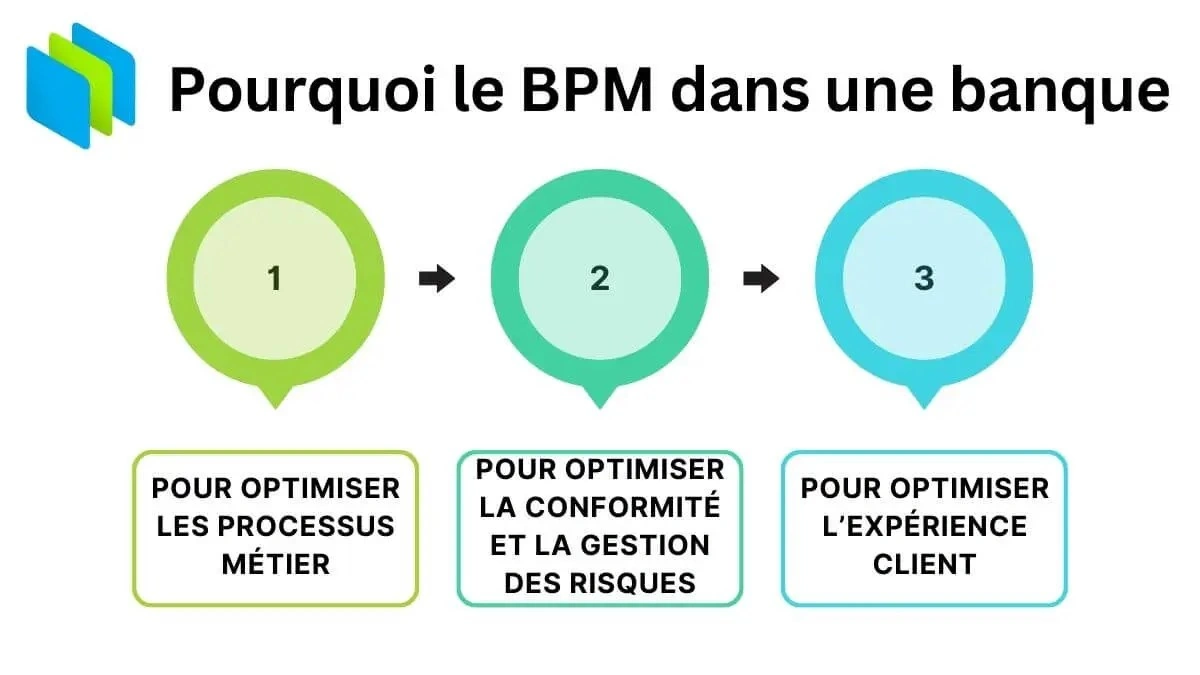
a) To optimize business processes
Implementing BPM (Business Process Management) in a bank brings real transformation to the management of business processes.
First of all, it allows you to optimize every step of banking processes, making overall operations smoother and more efficient.
Thanks to better management of workflows, repetitive and manual tasks can be automated, which leads to cost reduction.
Human resources can then focus on higher-value activities, which improves the productivity of the organization.
As a result, processing times — whether for account openings, loan processing, or complaint handling — are reduced.
This translates into greater responsiveness toward customers, reinforcing their satisfaction and loyalty.
In addition, this optimization also enables better risk management by ensuring full traceability of operations, which is essential to meet regulatory requirements.
b) To improve compliance and risk management
With evolving regulations in the banking sector, it is essential for institutions to be able to adapt quickly while ensuring the reliability of their operations.
With BPM, banks can automate a large portion of regulatory controls, which minimizes human errors and ensures that each process complies with current standards.
At the same time, BPM strengthens the traceability of operations.
Every step of a process is rigorously documented and tracked, which facilitates audits and checks by competent authorities.
Therefore, in the event of regulatory change, banks can quickly adjust their processes to remain compliant without disrupting their activities.
Finally, by integrating BPM, banks improve their ability to manage risks.
Critical processes are better monitored, automatic alerts enable rapid detection of anomalies, and corrective measures can be taken proactively.
Thus, BPM becomes an indispensable tool for banks that want not only to comply with regulatory requirements but also to anticipate and mitigate risks related to their operations.
c) To enhance the customer experience
BPM is a powerful lever to transform the customer experience in the banking sector.
By integrating BPM, banks can more finely personalize their services by relying on better management of customer data and business processes.
This personalization influences customer satisfaction and long-term loyalty.
Another major advantage of BPM is the reduction of waiting times.
By automating and optimizing processes such as account opening or closure, loan approvals, or complaint handling, banks can process requests faster.
Customers thus benefit from faster and smoother services, which improves their perception of the institution.
Practical example
Let’s take the example of a bank that implemented BPM to personalize its services.
Thanks to this approach, it can identify customers interested in mortgage loans based on their transaction history and financial profile.
Consequently, these customers can receive personalized offers perfectly aligned with their projects, without having to provide additional information.
This responsiveness and precision can not only simplify the customer journey but also increase the conversion rate of proposed offers.
In summary, BPM doesn’t just improve banks’ internal processes; it directly impacts the quality of the customer experience by making services more personalized, faster, and more advantageous.
2) How to implement BPM in a bank?
a) The assessment and mapping phase of existing processes
Before implementing BPM in a bank, the assessment and mapping phase of existing processes is essential.
Indeed, this step provides a precise inventory of current operations.
By mapping processes, the bank can clearly visualize each step of the workflows, highlighting problems, redundancies, and bottlenecks that slow down operations.
Thus, in-depth process analysis helps identify improvement points.
For example, some repetitive manual tasks can be automated, or unnecessary steps can be removed, which simplifies the process.
Moreover, this mapping reveals compliance or security risks that must be addressed before moving further with the BPM project.
The assessment and mapping phase is decisive for preparing the ground.
It allows you to understand where weaknesses and improvement opportunities lie, ensuring that BPM is implemented in an operational way with a direct and positive impact on performance.
b) Selecting the BPM solution
Choosing the BPM solution is a determining step for the success of the project.
It is important to select a solution that integrates harmoniously with existing systems.
Compatibility is essential to avoid integration issues that could slow down deployment or, worse, cause service interruptions.
It is therefore important to verify that the BPM solution can easily communicate with databases, customer information management systems (CRM), and existing software.
Flexibility is also a major criterion.
A BPM solution must be able to adapt to the bank’s needs, which may evolve over time.
A flexible platform makes it possible to adjust processes according to changes in regulations or customer expectations without requiring a complete overhaul.
Finally, scalability of the solution is a key factor.
It is important to ensure that the chosen BPM solution can grow with the company.
Whether it is to:
- 1️⃣ Handle a larger number of transactions
- 2️⃣ Integrate new technologies such as artificial intelligence
- 3️⃣ Expand to new subsidiaries
The solution must be able to support the bank’s growth without compromising performance.
c) Change management and staff training
Change management is a critical component to ensure the successful implementation of a BPM solution in a bank.
Indeed, when a new technology or process is introduced, employees may naturally feel some resistance or apprehension.
That is why you must prepare and support your teams throughout this transition.
Thus, staff training is a central element of this change management.
Each employee must be trained not only in using new tools but also in understanding the benefits they bring to their daily professional life.
Well-designed training tailored to each person’s skill level helps remove adoption barriers and ensures everyone uses the BPM solution optimally from deployment.
At the same time, internal communication plays a key role.
It is important to maintain clear and open communication about the reasons for the change, the expected benefits, and upcoming steps.
This can include:
- information meetings,
- internal newsletters,
- or awareness workshops.
By involving teams from the start and giving them space to express questions or concerns, management can foster a climate of trust and buy-in.
d) Measuring performance and continuous improvement
Once BPM is implemented, you must regularly monitor performance to ensure initial objectives are met and that processes continue to improve.
To do this, defining and tracking KPIs (key performance indicators) is mandatory.
These KPIs make it possible to measure:
- The efficiency of automated processes.
- Customer satisfaction.
- Regulatory compliance.
- And the productivity of teams.
Dashboards play a major role in this monitoring.
They provide an overview of performance in real time, allowing managers to quickly identify strengths and areas that need adjustment.
For example, a dashboard can show the average processing time of customer requests or the error rate in transactions.
Based on this data, continuous adjustments can be made to further improve processes.
Practical exercise: how to define relevant KPIs for your BPM project?
- Determine project objectives: start by clearly defining the goals of your BPM implementation. For example, is it to improve customer satisfaction, reduce costs, or strengthen compliance? Your KPIs should reflect these objectives.
- Choose measurable KPIs: ensure each KPI is quantifiable. For example, if the intent is to improve customer satisfaction, a relevant KPI could be "time to resolve complaints."
- Ensure KPIs are specific: avoid too vague KPIs. For example, instead of "improve productivity", define a KPI such as "reduce loan processing time by 20% in six months."
- Involve stakeholders: consult the teams involved to define KPIs that are not only relevant but also acceptable and realistic for those responsible for them.
- Review and adjust regularly: KPIs should be reassessed regularly to ensure they remain aligned with company objectives. If a KPI no longer provides value, it can be adjusted or replaced.
3) Use cases of BPM in a bank with AirProcess
a) Tracking amicable settlement negotiation files
This type of process often involves multiple steps, interactions with different departments, and careful management of deadlines and documents.
With a BPM solution, the bank can automate and structure this tracking, making the process more transparent and robust.
1) Centralization of information
BPM makes it possible to centralize all information related to an amicable negotiation file, including communications with the customer, legal documents, and provisional agreements.
Everything is accessible from a single interface, which makes case management easier.
2) Automation of reminders and notifications
BPM can be configured to automatically send reminders and notifications to case managers when an action is required or when a deadline is approaching.
This reduces the risk of delays in case processing.
3) Real-time tracking
Managers can track the progress of each file in real time.
They can see which steps have been completed, what actions remain, and immediately identify any blockages.
4) Improved traceability
Every interaction and change made to the file is recorded in the system, providing full traceability.
This is particularly useful in case of dispute or audit need, as all actions are documented.
5) Reporting and analysis
BPM enables the generation of detailed reports on all amicable negotiation files, offering insights into processing times, negotiation success rates, and areas where improvements are possible.
6) Concrete example
Imagine a bank that regularly handles amicable negotiation files for distressed debts.
Before integrating AirProcess, tracking these files was done manually, relying on scattered Excel sheets and email exchanges between departments.
This approach inevitably led to delays, oversights, and a fragmented view of each file, making management ineffective.
By adopting AirProcess, the bank can transform this process into an automated and centralized workflow.
From the opening of a file, all information is entered into a customized form and integrated directly into the platform.
Each file follows a predefined path, with clear steps from initial analysis to case closure.
Managers receive automatic notifications at each important stage, informing them of actions to take or approvals required.
Thanks to AirProcess, information is shared instantly among all relevant teams, eliminating information silos and the risk of duplicate tasks.
Processing times are significantly reduced because repetitive tasks are automated, and managers can focus on the strategic aspects of negotiations.
Additionally, the bank improves its relationships with customers by offering transparent and responsive follow-up.
Customers are kept informed of the progress of their file in real time, which strengthens trust and satisfaction.
This case illustrates how AirProcess can turn a distressed debt management process into a smooth, optimized, and fully controllable workflow while improving performance and customer relations.
b) Tracking litigation files when amicable negotiation fails
When an amicable negotiation fails and a case moves to litigation, management becomes even more critical, involving complex steps, strict legal procedures, and often significant financial stakes.
In this case, Business Process Management proves to be a fundamental asset for handling these files.
1) Structured management of legal steps
BPM allows modeling the litigation process by integrating all legal steps, from case preparation to enforcement of judicial decisions.
Each step is clearly defined and assigned, ensuring all procedures are followed correctly and without omission.
2) Automation of repetitive tasks
BPM automates recurring tasks such as generating standard legal documents, sending notifications to concerned parties, and tracking legal deadlines.
This automation reduces manual workload and minimizes errors.
3) Real-time monitoring and reporting
With BPM, managers can track the progress of litigation files in real time.
Interactive dashboards provide up-to-date information on timelines, completed steps, and next actions to take.
BPM also enables generating detailed reports, which facilitates portfolio management of litigation cases.
4) Risk management and compliance
BPM ensures rigorous management of compliance with applicable regulations.
Every action taken is traced and documented, which is necessary to avoid non-compliance risk.
In case of inspection or audit, BPM offers full traceability and complete transparency of actions taken.
5) Coordination of teams and external parties
BPM facilitates coordination between different internal actors (legal, accounting, etc.) and external parties (lawyers, bailiffs) involved in a litigation file.
Information is shared in real time, improving collaboration and the overall responsiveness of all participants.
6) Concrete example
Imagine a bank that, after the failure of an amicable negotiation, must initiate litigation to recover a significant debt.
Before using AirProcess, litigation management was often disorganized, with information scattered across services and non-integrated tools, leading to delays and costly errors.
Using AirProcess, here is how the bank could transform its management process for litigation:
- Centralization of files: as soon as the decision to go to litigation is made, the file is immediately recorded in AirProcess. All relevant documents, such as correspondence with lawyers, evidence of claims, and judicial acts, are centralized in a single space accessible to all involved parties. This gives the bank a complete and up-to-date view of each case.
- Automation of reminders and notifications: AirProcess allows the bank to configure automatic reminders for each key step of the litigation process. For example, if a document must be filed with a court within a specific timeframe, AirProcess automatically notifies the responsible parties to ensure the deadline is met. This helps the bank avoid delays and comply with strict legal timeframes.
- Automatic document generation: with AirProcess, the bank can automatically generate all documents required for litigation, such as summons, procedural acts, or formal demand letters. These documents are preformatted and populated with relevant information extracted directly from the files, which reduces preparation time and minimizes the risk of errors.
- Real-time tracking of case progress: bank managers can track the progress of each litigation file in real time via AirProcess dashboards. This allows them to see which steps have been completed, what remains to be done, and where interventions are necessary. In case of blockage, managers can intervene quickly to resolve issues.
- Smooth coordination between teams: AirProcess facilitates collaboration between the different teams involved in litigation, whether legal services, collections teams, or financial officers. Each team member can access the information they need, add comments, and track the progress of tasks assigned to them. This fluid coordination reduces timelines and improves the efficiency of the litigation process.
Therefore, if the bank used AirProcess to manage its litigation files, it would benefit from a much more structured, transparent, and streamlined process.
This would not only reduce costs and errors but also ensure better management of legal deadlines and optimal coordination between teams, strengthening its ability to recover outstanding debts.
c) Tracking debt recovery files if litigation fails
Tracking debt recovery files when litigation fails is a critical stage for banks.
At this point, efforts focus on recovering unpaid debts, often with high financial stakes.
1) Centralization of recovery information
All relevant information on recovery files is centralized in one system.
This includes the interaction history with the debtor, legal actions taken, and previous recovery attempts.
This centralization gives managers a complete overview and enables informed decision-making.
2) Automation of reminders and actions
BPM can automate the sending of payment reminders, demand letters, and other communications needed for recovery.
Moreover, predefined actions can be triggered automatically depending on responses or lack of responses from the debtor, accelerating the recovery process.
3) Priority management and escalations
The system helps prioritize cases based on criteria such as amount owed, delinquency duration, or likelihood of recovery.
The most critical cases can be automatically escalated for special attention, ensuring resources are focused where they are most needed.
4) Real-time tracking and reporting
Thanks to interactive dashboards, managers can follow the evolution of recovery files in real time.
They can view the status of each file, amounts recovered, and ongoing actions.
These reporting tools also help identify high-risk cases quickly and take corrective measures.
5) Improved traceability and compliance
Every action taken as part of recovery is traced in the BPM system.
This traceability ensures compliance with recovery regulations and provides complete documentation in case of dispute.
6) Concrete example
Imagine a bank that must handle multiple recovery files after litigation procedures failed.
Before adopting AirProcess, these files were processed manually, which created a high risk of errors, delays, and poor coordination between the different services involved.
This lack of organization could lead to financial losses and inefficient use of resources.
Using AirProcess, the bank transforms its recovery process into a structured and automated workflow, with tangible benefits at each stage of the process.
Here is what the bank would do with AirProcess:
- Automation of payment reminders: as soon as a recovery file is opened in AirProcess, the system automates mailing for installment payments. These reminders are personalized based on deadlines and amounts owed, and are sent automatically on predefined dates. This reduces the risk of late payments and ensures each debtor is regularly informed of their situation.
- Automatic triggering of actions based on debtor responses: AirProcess is configured to react according to debtor responses or lack thereof. For example, if a debtor accepts a payment plan, an automatic action can trigger the sending of documents needed to formalize the agreement. If the debtor does not respond, the file can be automatically escalated to a higher level or marked for additional legal action.
- Identification and management of priority files: thanks to AirProcess sorting and filtering features, bank managers can easily identify the most critical recovery cases. Files are ranked by priority based on defined criteria such as amount, age of the debt, or associated risk. This enables teams to focus on the most urgent cases, optimizing resource use.
- Complete traceability of actions: every action taken during recovery is recorded in AirProcess, ensuring full traceability. This means the bank can at any time prove it followed all legal procedures required for recovery. This traceability is essential in case of dispute or inspection, ensuring all steps were carried out transparently and in compliance with regulations.
- Simplified coordination between services: AirProcess facilitates collaboration between different services involved in recovery, such as legal, financial, and collections teams. Each service can access the information it needs, track the progress of files, and add real-time updates. This coordination reduces communication errors and improves process efficiency.
The bank therefore moves from manual and fragmented management of recovery files to a smooth, automated, and well-coordinated process.
d) Tracking customer fee refund requests (with approval levels based on amounts)
Tracking customer fee refund requests (also called reversal management) is a delicate process for banks.
Indeed, it involves not only managing requested amounts but also respecting different approval levels depending on the sum involved.
BPM can greatly improve this process by ensuring smooth, transparent management that complies with the institution’s internal policies.
1) Automation of workflows according to amounts
BPM allows configuring specific workflows based on the amounts of refunds requested.
For example, for small amounts, the request can be approved automatically or by a basic validation level.
Conversely, for larger amounts, BPM will automatically route the request to higher approval levels for authorization, in accordance with the bank’s internal rules.
2) Traceability and transparency of decisions
Every step of the refund request is traced in the BPM system.
This includes who approved, rejected, or modified the request, as well as associated reasons.
This traceability ensures process transparency, which is useful in case of dispute or review.
3) Reduced processing times
BPM helps reduce processing times for refund requests by automating manual tasks and eliminating bottlenecks.
Automatic notifications are sent to responsible parties to ensure validations are performed quickly, avoiding the delays often associated with multiple approvals.
4) Exception handling and escalations
BPM also handles exceptions, such as non-compliant refund requests or those requiring special attention.
If a request exceeds a certain amount threshold or presents anomalies, the system can automatically escalate the file to a higher level or alert the responsible parties.
5) Integration with existing systems
BPM can integrate with the bank’s accounting and financial systems to ensure approved refunds are processed smoothly and without errors.
This avoids double entries and guarantees refunds are made in a timely manner.
6) Concrete example of tracking customer fee refund requests
Imagine a bank that regularly receives refund requests for fees, with amounts ranging from a few dozen to several thousand euros.
Before adopting AirProcess, these requests were often handled ad hoc, leading to variable processing times and a lack of transparency, especially for higher amounts requiring multiple approval levels.
By using AirProcess, the bank can transform this process into an automated and structured workflow, bringing clarity and efficiency at every step.
Here is what the bank would do with AirProcess:
- Automatic categorization of requests by amount: As soon as a refund request is submitted via AirProcess, it is automatically categorized by amount. Small requests, for example those under €100, are directed to a fast validation path, often handled immediately by the first-line manager. Larger refund requests, which require more rigorous review, follow a more structured approval process with multiple validation levels.
- Hierarchical validation and automatic notifications: AirProcess allows configuring specific validation paths according to amounts and criteria defined by the bank. Responsible parties receive automatic notifications to approve or reject requests according to their level of authority. This ensures each request is handled by the appropriate person in line with the bank’s internal policies.
- Real-time tracking of requests: thanks to AirProcess, employees can track the status of their refund request in real time. They can see when their request is approved, rejected, or awaiting additional validation. This transparency reduces uncertainty and improves employee satisfaction.
- Traceability and documentation of decisions: every step of the refund process is traced in AirProcess. Decisions made, validations performed, and reasons for rejection (if any) are all automatically documented in the system. This greatly simplifies internal audits and compliance checks by providing a complete and accessible view of the processes followed.
- Reduced processing times: thanks to automation and workflow efficiency, the bank can significantly reduce the time required to process refund requests. Processes are optimized to minimize delays, whether for small amounts or sums requiring multiple approval levels.
Now, the bank benefits from a faster, more transparent, and more compliant fee refund process.
Customers are reassured by the transparency and speed of request processing, and the bank can ensure all approvals are performed correctly, on time, and in accordance with internal policies.
e) Tracking internal staff mobility
BPM optimizes this process by ensuring centralized, transparent, and consistent management of internal movements.
1) Centralization of mobility requests
BPM centralizes all internal mobility requests from staff.
Each employee can submit their request via a dedicated portal, specifying job preferences, motivations, and skills.
This facilitates management and tracking of these requests by HR and relevant managers.
2) Automation of validation processes
Once a mobility request is submitted, BPM automatically triggers the validation process, which may include several levels depending on the desired position or internal policy.
For example, a transfer request to another department may require approval from the current manager, the HR manager, and the director of the receiving department.
BPM ensures each step is validated in the required order without risk of blockage.
3) Real-time and transparent tracking
Employees can track the status of their request in real time, from submission to final decision.
BPM records all actions taken, guaranteeing process transparency and allowing HR managers to justify their decisions if necessary.
4) Skills management and job fit
BPM integrates skills assessment tools to ensure applicants for a new position have the necessary qualifications.
If a gap is detected, training or development actions can be recommended before final validation of the mobility.
5) Reporting and analysis of internal movements
Thanks to BPM, HR can generate detailed reports on internal mobility, identify trends, and evaluate the effectiveness of mobility policies.
This data is essential to adjust HR strategies and ensure internal mobility contributes to the company’s growth while meeting employee expectations.
6) Concrete example
Imagine a large bank where internal staff mobility is strongly encouraged to foster career development.
Before integrating AirProcess, mobility requests were handled manually, causing delays, a lack of transparency, and sometimes notable frustration among employees who had little visibility on the progress of their requests.
By adopting AirProcess, the bank can transform this internal mobility process into an optimized and fully automated workflow, bringing benefits to both employees and the organization.
Here is what the bank would do with AirProcess:
- Systematic recording of mobility requests: as soon as a staff member submits a mobility request via AirProcess, it is immediately recorded in a centralized system. All relevant information, such as the desired position, the employee’s current skills, and career aspirations, is captured in customized forms, ensuring nothing is left out.
- Personal dashboard for employees: Employees have access to a personal dashboard on AirProcess where they can track the progress of their request in real time. They can see which skills are required for the desired position, check if all steps of the process are completed, and receive automatic notifications if an action is missing or required of them. This provides full transparency and reduces uncertainty.
- Visibility for managers and HR: managers and HR leaders gain an overview of all ongoing mobility requests. With AirProcess, they can quickly identify vacant positions, potential candidates, and missing skills. This visibility allows faster, more informed decisions aligned with employees’ aspirations.
- Structured process and automated validation: AirProcess structures the internal mobility process from request submission to final decision. Necessary validations, such as those from managers or HR, are automated and follow a predefined path. Decisions are documented in the system, ensuring full traceability and facilitating internal audits.
- Improved employee satisfaction: with AirProcess, internal mobility processes are not only faster but also more transparent and better aligned with HR development goals. As a result, employees feel better supported in their career paths.
As a result, the bank notices a significant improvement in managing internal mobility.
Processes have become smoother, decisions are made faster, and employees have better visibility on their future within the organization.
AirProcess thus enables the bank to strengthen its talent development strategy while optimizing the operational efficiency of its human resources.
5) Conclusion
Throughout this article, we explored how Business Process Management (BPM) can transform the banking sector.
By optimizing business processes, BPM not only reduces costs and improves resource management but also delivers greater transparency and enhanced compliance.
In a banking context where competition is fierce and regulations continually evolve, BPM offers banks a unique opportunity to stand out.
If you would like to deepen your understanding of BPM and discover how it can be applied in other areas of your bank, feel free to explore our other articles and resources. You will find practical guides, case studies, and advice to further optimize your business processes.
Are you considering integrating BPM into your organization?
What would, in your opinion, be the first step to transform your current processes?
Take a moment to reflect on how these changes could not only improve your operations but also strengthen satisfaction among your customers and teams.
Each step toward better process management is a step toward a stronger and more competitive future for your bank.