

Imagine a solution that enables your company to manage, optimize and automate its business processes with surgical precision.
That is exactly what Business Process Management (BPM) can offer.
But how do you turn that promise into reality?
This is where your journey begins.
In this article, we will dive into best practices for adopting an effective BPM, showing you how each step, from flow modeling to tool integration, can dramatically improve the management of your operations.
You will discover how AirProcess (your BPM Software) can simplify communication between stakeholders, reduce costs, and improve service quality.
By following our guide, you will learn not only how to analyze your needs and model your workflows, but also how to ensure an implementation that delivers concrete solutions aligned with your objectives.
Ready to transform your company into a well-oiled machine?
Dive into this read and see how BPM can become the engine of your success.
1) Understanding the Fundamentals of BPM
a) What is BPM?
Business Process Management (BPM) is a structured approach that enables the management, improvement and optimization of processes within a company.
It helps to model the different steps of business activities, analyze how they operate, and provide solutions where needed.
BPM plays a central role in managing a modern company by ensuring that each process is aligned with strategic objectives.
The ultimate goal is that in a process involving several people or departments:
- everyone always knows what they must do, without relying on emails
- information flows automatically between actors
- you have an overall view of everything in progress, and especially which stage of the process it is at
- you have full traceability of actions performed
The systematic result of implementing BPM is that you save time every day.
b) Key Principles of BPM
1) Process Optimization
BPM plays a foundational role in identifying and eliminating issues that slow down or complicate processes.
With a BPM approach and analysis of each step, it becomes possible to spot problems and correct them, making operations smoother.
Thus, BPM enables end-to-end management of business processes, ensuring consistency across all stages.
2) Automation
Automation is at the heart of BPM!
It allows repetitive tasks to be delegated to systems, freeing up time for teams and reducing the risk of human error.
As a result, processes become faster and more reliable.
3) Agility and Flexibility
BPM provides the ability to quickly adapt processes to changes, whether they are new regulations, market fluctuations, or technological innovations.
c) Benefits of BPM
1) Cost Reduction
By optimizing processes and eliminating redundancies as much as possible, BPM reduces wasted time, which directly impacts financial results.
2) Quality Improvement
Standardizing processes reduces errors, so BPM enables the production of higher-quality goods or services that better meet customer expectations.
3) Increased Customer Satisfaction
Well-organized BPM improves the customer experience by offering fast and efficient services, which strengthens customer loyalty.
4) Operational Performance
Thanks to better process organization and automation, companies can maximize their productivity and reach their goals more advantageously.
For example, automation in customer service through BPM improves customer satisfaction.
2) Key Steps for a Successful BPM Implementation
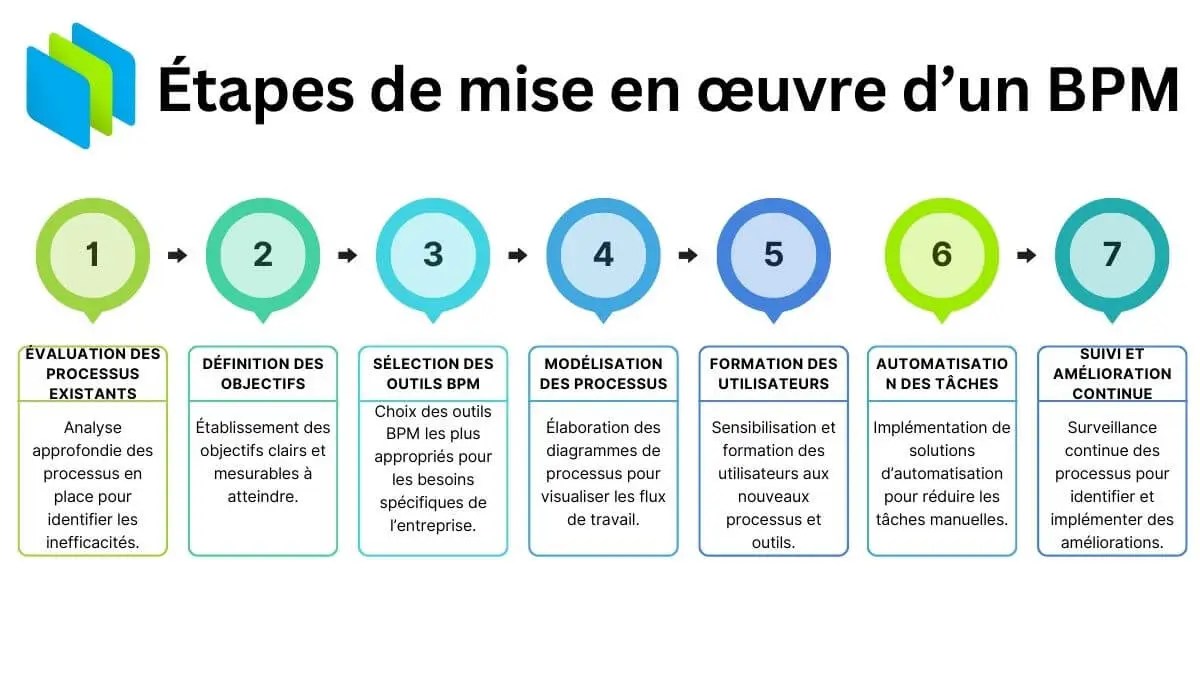
The 7 essential steps to implement an effective BPM, from evaluating existing processes to continuous improvement.
a) Assessing Process Maturity
Level | Description | Example Process | Recommended Actions |
Initial | Ad hoc and poorly structured processes | Email management | Map and formalize |
Repeatable | Repeated processes, but undocumented | Invoice processing | Document and standardize |
Defined | Documented and standardized processes | Order management | Optimize and automate |
Managed | Measured and controlled processes | Customer support | Refine and improve |
Optimized | Continuously optimized processes | Inventory management | Innovation and continuous improvement |
1) Initial Process Analysis
The first step to succeed in implementing BPM is to assess existing processes.
This initial analysis helps understand how current processes work and where improvement points are.
To do this, you must map processes in order to identify bottlenecks, and collect data on current performance.
This information will serve as the basis for planning necessary adjustments.
2) Maturity Methods
Once processes are analyzed, you should evaluate their maturity level.
This can be done using recognized frameworks, such as the CMMI (Capability Maturity Model Integration) model.
This model allows processes to be classified on a maturity scale, ranging from the initial level where processes are poorly structured, to an optimized level where processes are continuously improved.
Therefore, this assessment guides the company in developing an action plan to improve processes and reach a higher level of maturity.
b) Defining Clear and Measurable Objectives
Example KPI tracking table in a BPM project
KPI | Target | Current Value | Gap | Corrective Actions |
Cycle time | 5 days | 7 days | +2 days | Reassess process steps |
Customer satisfaction rate | 90% | 85% | -5% | Support team training |
Cost per process | €100 | €120 | +€20 | Automate certain tasks |
1) KPIs and Performance Indicators
For BPM to be truly effective, you must set clear and measurable objectives.
This involves identifying KPIs (Key Performance Indicators) and other relevant performance indicators.
These indicators should be chosen according to the company's priorities and should reflect the important aspects of business processes.
Thus, tracking these KPIs will allow you to regularly evaluate performance, detect deviations from set objectives, and adjust actions accordingly to stay on track.
2) Alignment with Strategy
Objectives defined within BPM must be in perfect harmony with the company's overall strategy.
This means that each BPM objective should help achieve your company's strategic ambitions.
Therefore, aligning BPM objectives with company objectives ensures that all efforts to improve processes converge toward a common goal, increasing coherence and efficiency.
c) Process Design and Modeling
1) Modeling Tools and Techniques
Process design and modeling are steps not to be missed in order to visualize and understand workflows within a company.
Among the most used tools for this task are BPMN (Business Process Model and Notation) and UML (Unified Modeling Language) for optimizing management processes.
BPMN is particularly suitable for modeling business processes, offering an easily understandable graphical notation.
UML, on the other hand, is often used for modeling more complex systems and representing interactions between different system elements.
These tools allow the creation of clear and detailed diagrams, which facilitate communication between teams and the identification of points to improve.
2) Practical Cases.
However, process modeling can seem abstract, but it makes sense when applied to concrete cases.
For example, in the banking sector, BPMN is used to model the loan approval process, allowing each step to be visualized from file processing to final approval.
In healthcare, UML helps model a patient's journey from admission to discharge, while integrating interactions with different hospital services.
These examples show how process modeling improves efficiency and quality of operations across various sectors.
d) Automation and Integration
1) Integrating AirProcess
To automate business processes effectively, the choice of tools is decisive.
Thus, AirProcess is an example of a tool that can be integrated to automate and manage workflows more smoothly.
Tip: when selecting a tool such as AirProcess, you should consider several criteria, such as:
- Compatibility with the company's specific needs
- Ease of use
- Ability to adapt to future changes
- Technical support and the assistance provided by the vendor
Thus, choosing the appropriate tool maximizes the benefits of automation while precisely meeting the company's requirements.
2) Integration with Existing Systems
Automation can only be fully effective if integration with the company's existing systems is seamless.
To achieve this, ensure that the chosen tool integrates easily with your other systems such as your ERP, your CRM, or any other existing business software.
Successful integration ensures that data flows freely between different systems, avoiding information silos and enabling more coherent process management.
To achieve this, it is recommended to work closely with IT teams and to carefully plan each step of the integration.
3) Best Practices to Ensure the Effectiveness of Your BPM with AirProcess
a) Modeling
To ensure that BPM is functional, it is essential to think simply when modeling processes.
A clear approach without unnecessary complexity allows optimal results to be achieved more quickly.
1) Define the Process Steps
The first step is to identify and define the different steps of the process.
Thus, you understand that it is important to clearly understand each phase in order to model it correctly.
2) Define Possible Decisions at Each Step
At each step of the process, determine what decisions can be made.
This allows you to anticipate different scenarios and ensure the process remains fluid and adaptable.
3) Minimize the Number of Steps
It is recommended to limit the number of process steps rather than trying to over-detail it.
An overly detailed process risks becoming complex and difficult to manage.
Simplicity is often the key to a successful implementation.
4) Involve Users as Early as Possible
Involving users from the start of flow formalization is important.
Indeed, this ensures that the process will meet real needs and will be well received by those who will use it daily.
5) Set a Testing Period and Stick to It
Before deploying the process at scale, it is advisable to schedule a testing period.
This phase allows you to detect and correct potential problems before the official launch.
6) Go Live After the Testing Phase
Once testing is complete, the process can be put into production.
This marks the beginning of the actual use of the process within the company.
7) Collect Feedback and Improve the Process
After launch, it is essential to collect user feedback for a month.
This feedback helps identify areas for improvement.
If possible, it is recommended to simplify the process further by removing unnecessary steps.
b) Summary Views
1) Create Clear and Relevant Summary Views
To facilitate access to information, it is crucial to create summary views that allow users to access directly the data they need.
These views should be designed to display the most relevant information without unnecessary overload.
Therefore, dashboards are useful for monitoring processes and quickly accessing key information.
2) Limit the Number of Views
It is important to limit the number of views to relevant users.
Not everyone needs access to every available view.
By customizing views according to each user's roles and responsibilities, you ensure that everyone has the information they truly need.
3) Use Grouped Views for an Overview
Grouped views are an excellent way to get an overview of the process.
Indeed, grouping data across multiple levels, combined with aggregations on numeric columns, makes it possible to synthesize complex information into a more usable format.
4) Group Data by Key Steps
Rather than creating a distinct view for each process step, it is better to group data by key steps.
This simplifies access to information while providing a coherent and relevant overall view.
5) Examples of Summary Views
- New request creation: a view that groups all newly initiated requests, allowing you to monitor their progress.
- Requests pending approval: a specific view for requests that require validation before moving to the next step.
- Requests blocked due to missing information: this view identifies requests that cannot progress because of missing necessary data.
- Approved requests: a view grouping all requests that have been validated and are ready for implementation.
- Rejected requests: a view dedicated to requests that have been declined, allowing you to understand and document the reasons for rejection.
c) Keep It Simple
You must keep in mind that simplicity is the key to success.
When tools or processes become too complex, users tend to avoid them or look for ways to circumvent them.
By keeping things simple, you encourage wider adoption and effective use of the systems in place.
Simplicity not only makes onboarding easier, but also ensures that users remain engaged and use the tools optimally.
b) Training and Skills Development
1) BPM Training Programs
To ensure BPM succeeds in your company, you should follow quality training programs.
There are several specialized BPM trainings, and it is important to choose those that best match your organization’s needs.
On this point, AirProcess can help you — click the button below to book your demo slot.
These trainings should cover key aspects of BPM such as process modeling, automation, and project management.
By choosing appropriate training programs, you ensure your teams are well prepared to implement and optimize business processes.
2) Developing Internal Skills
It’s not just a matter of external training!
Indeed, developing internal skills is equally important.
Training your employees in business process management helps create lasting expertise within the company.
By developing these skills internally, you strengthen your organization’s ability to manage processes autonomously while fostering a culture of continuous improvement.
This ensures that knowledge remains within the company and is applied consistently.
c) Continuous Process Improvement
1) Feedback Loops
To ensure processes remain robust and adapted to business needs, it is essential to regularly collect feedback.
These feedback loops help quickly identify weaknesses and areas for improvement.
Thus, collecting user opinions and analyzing the data gathered allows you to proactively adjust processes, contributing to their continuous optimization.
This approach ensures that processes evolve according to field realities and user expectations.
2) Lean and Six Sigma Methodologies
Comparison table between BPM and other methodologies (Lean, Six Sigma)
Methodology | Main Objective | Advantages | Disadvantages | Best Use |
BPM | Optimization of business processes | Automation, flexibility | Sometimes complex to implement | End-to-end process management |
Lean | Waste reduction | Simplicity, efficiency | Not well suited to complex processes | Production, logistics |
Six Sigma | Quality improvement | Variation reduction, rigor | Lengthy implementation | Industrial processes, quality |
To reinforce continuous process improvement, it is useful to integrate methodologies like Lean and Six Sigma.
Lean focuses on eliminating waste and improving process flow, while Six Sigma aims to reduce variation and improve quality.
Using these complementary methodologies allows you to adopt a structured approach to refine processes continuously.
Thus, your organization can reach a higher level of performance by optimizing processes in a methodical and rigorous way.
4) The Impact of Emotional Intelligence on BPM Adoption
Emotional intelligence (EI) plays a decisive role in the adoption of Business Process Management (BPM) within companies.
Leaders with high emotional intelligence are better able to understand their teams' emotions, which can greatly facilitate the implementation of new processes.
Recognizing and addressing employees’ fears or reluctance creates an environment more receptive to the changes induced by BPM.
When implementing BPM, employees’ emotions should not be neglected.
Indeed, the processes of collaborative processes improve when teams feel understood and supported.
Thus, an empathetic leader, able to listen and respond to the emotional needs of their team, promotes a smoother transition to new practices.
As a result, emotional intelligence not only improves employee engagement, it also contributes to BPM’s overall success.
To effectively integrate emotional intelligence into business process management, a few techniques can be applied.
First, it is useful to train leaders to recognize and manage emotions, both their own and those of their teams.
Next, establish moments for discussion where employees can express their feelings about changes, which adds a human dimension to the process.
Finally, encourage a culture of regular feedback to maintain a climate of trust, essential for BPM adoption.
Emotional intelligence is a major asset in BPM adoption: it is often the pivot of the support phase at the start of projects.
5) The Impact of Company Culture on BPM Effectiveness
Company culture plays a determining role in the success or failure of BPM implementation.
A culture that values innovation, transparency, and continuous improvement encourages the adoption of new BPM practices.
Thus, employees are more inclined to accept and support BPM initiatives when organizational values foster receptivity to change.
In contrast, in a company culture where resistance to change is strong, BPM implementation may encounter significant obstacles.
It is very important to make clear that implementing BPM is not a performance monitoring tool, but above all a tool to simplify and streamline daily work. The employee therefore benefits just as much as the company from adopting this type of tool.
An approach that integrates these cultural elements will maximize the chances of BPM success, ensuring that new practices are well integrated and supported at all levels of the organization.
6) Using Gamification Techniques to Improve BPM Adoption
Gamification techniques can play a key role in BPM adoption by making processes more engaging for employees.
By applying gamification principles, you can turn daily tasks into motivating challenges.
For example, by establishing a rewards system for users who complete processes quickly and correctly, you encourage active participation.
These rewards can take the form of badges, points, or even special privileges.
To implement gamification in a BPM system, it is useful to follow a practical guide that includes concrete steps and examples.
This could include games that reward cross-team collaboration or leaderboards that motivate users to improve their performance.
The goal is to create an environment where each employee feels invested in the success of processes while making the experience more playful and interactive.
7) The Role of BPM in Knowledge Management within Organizations
Business Process Management (BPM) plays a considerable role in knowledge management within organizations.
Structuring information flows through BPM allows knowledge to be centralized and organized, making it easier to access at all levels of the company.
This includes not only explicit knowledge, such as procedures and documents, but also tacit knowledge, which is often difficult to formalize.
To capture and integrate this tacit knowledge into formalized processes, it is necessary to adopt appropriate strategies.
For example, BPM can include feedback mechanisms where employees share informal learnings and integrate them into existing processes.
This enriches processes and ensures that valuable knowledge is not lost but properly integrated and accessible to all.
To illustrate how BPM structures knowledge management, it is useful to include explanatory diagrams.
These diagrams can show how information flows and is stored within the organization.
8) Conclusion
In summary, Business Process Management (BPM) represents an essential approach to optimize processes within your organization.
By using best practices such as:
- simple and effective modeling
- involving users from the start
- using techniques such as gamification
You can improve not only process management but also knowledge management within your company.
Additionally, integrating continuous feedback and adapting processes accordingly helps maintain a dynamic of constant improvement.
By implementing these practices, you position your company to respond quickly to changes while optimizing internal operations.
Do not let complexity or resistance to change slow your progress.
Commit now to transforming your business processes to ensure the sustainability and growth of your company.